The online version of this article (https://doi.org/10.18148/srm/2026.v20i3.8548) contains supplementary material.
Survey experimental studies on political behavior and corruption have grown exponentially in recent years. This research shows that corruption can reduce a voter’s support for an incumbent and that positive partisanship can moderate that relationship. Yet, it has overlooked an essential part of political identities: citizens’ deep-rooted aversions to specific political parties. While negative partisanship is a frequent feature of electoral politics today, the relationship between partisan hostilities, corruption, and voting has not been extensively studied. Our project aimed to fill that gap by examining the extent to which corruption voting happens differently for positive, negative, and nonpartisans.
We designed a survey experiment to be fielded in Brazil between the first and second rounds of the 2022 presidential elections.1 In our experimental design, respondents were randomly assigned to actual news excerpts about corruption involving politicians who have been at the center of recent scandals in Brazil. This realism was designed to avoid the pitfalls of manipulating hypothetical information in survey vignettes (Boas et al., 2019; Incerti, 2020). Rather than asking respondents to declare vote intentions for hypothetical candidates in a simulated campaign, we measured vote intentions for real presidential candidates close to the runoff election.
Analysis of the survey experiment revealed that exposure to corruption information did not negatively affect respondents’ likelihood of voting for Luiz Inácio Lula da Silva or Jair Bolsonaro, the two second-round candidates. Our preregistered study hypothesized that the extent of corruption voting would vary across positive, negative, and nonpartisans. While we found that negative partisans ignore corruption information as much as positive partisans do, we did not find that nonpartisans are more likely to penalize candidates for corruption. Our treatment did not significantly affect respondents’ likelihood of voting for Lula or Bolsonaro, regardless of their partisan attitudes towards the Partido dos Trabalhadores (PT) and the Partido Liberal (PL).
In this paper, we present the pre-registered survey experiment that we conducted and its null findings. We then demonstrate how additional measures from the same survey can be used to diagnose potential sources of null results. This effort elucidated a likely explanation: voters’ strongly held candidate preferences mattered more than corruption in the Brazilian election. We conclude the paper with some methodological insights that our project provides, particularly for scholars interested in survey experiments and corruption voting.
Theories of electoral accountability argue that voters hold elites accountable for poor performance while in office (Przeworski et al., 1999). Yet, empirical research has shown that this does not always happen in practice, especially in regard to corruption (e.g., Boas et al. 2019; Klašnja 2017; Dunning et al. 2019). A wide variety of individual and contextual conditions mitigate the electoral punishment of corrupt politicians (Agerberg, 2020; Elia and Schwindt-Bayer, 2022; Klašnja and Tucker, 2013; Pavão, 2018; Vera, 2022). One important factor moderating citizens’ propensity to sanction corrupt politicians is partisanship. Voters appear more willing to forgive corruption by politicians belonging to their preferred party (Anduiza et al., 2013; Ecker et al., 2015; Eggers, 2014; Klašnja, 2017; Solaz et al., 2019), although Klašnja, et al. (2021) and Winters and Weitz-Shapiro (2018) report divergent findings. Evidence of partisans discrediting or forgiving corruption when it occurs within their preferred party exists in a variety of country contexts, and such effects have been found in both experimental and observational studies.
We contend that while studies on partisanship and corruption voting have greatly contributed to our understanding of why citizens with affinities toward a party often fail to hold this party’s politicians accountable for corruption, they have neglected the study of citizens’ deep-seated hostility towards particular parties, an important component of political identities. Some studies show that large proportions of US voters now dislike the opposing party more than they like their own (Abramowitz and McCoy, 2019; Abramowitz and Webster, 2016), although other studies find that negative partisanship in the US is not as strong as positive partisanship (Lee et al., 2022). Citizens outside the US also feel a strong aversion towards the opposing party (Haime and Cantú, 2022; Medeiros and Noel, 2014; Samuels and Zucco, 2018), and the level of affective polarization in Europe is similar or greater than in the US (Gidron et al., 2019; Wagner, 2021).
Examining the relationship between negative partisanship, corruption, and voting may be especially relevant in less developed democracies where positive partisanship is less common and corruption is more prevalent. Due to weaker and less stable party systems, many voters in Latin American democracies do not express the same rates of partisan identification as voters in more developed democracies. However, a strong aversion towards a specific party can dictate how someone votes, even if positive feelings toward a party are absent. Negative partisanship may play a bigger role than “positive” partisanship in certain contexts, especially in Latin America (Samuels and Zucco 2018; Haime and Cantú 2022). Yet, existing work on partisanship and corruption voting focuses exclusively on positive partisanship and thus presents only a partial picture of how partisan attachments, corruption, and voting work.
Filling this research gap requires studying corruption voting behavior of negative partisans and nonpartisans together with that of positive partisans. Negative partisanship towards an out-party might mitigate the damaging repercussions of corruption allegations if citizens holding negative affect towards an out-party become reluctant to electorally punish an allegedly corrupt party in order to prevent the out-party from gaining office. In contrast, nonpartisans, who do not feel close to or hold a particular aversion to any party, should be less prone to partisan-motivated reasoning when they receive corruption information and, therefore, be more likely to engage in corruption voting. Hence, we expect that nonpartisans will be more likely to evaluate candidate information objectively and adjust their voting intentions accordingly, leading them to punish candidates for corruption more than partisan voters would.
Formally, we preregistered ten hypotheses specifying how corruption information affects different types of partisans. These hypotheses take into account who the corrupt information implicates, meaning we create expectations for how positive, negative, and nonpartisan individuals respond when the accused candidate is either a copartisan or an opponent of a copartisan.
We designed and embedded a preregistered experiment in an online survey of 1500 likely voters in Brazil (Elia et al., 2026).2 Netquest fielded the experiment between the first and second voting rounds of the 2022 presidential election. The Netquest sample is an opt-in survey model, and quota sampling was used to create a sample that is well-representative of the broader population. Appenidx Table A1 displays representativeness; our sample is slightly overepresentative of younger and college-educated Brazilians. The survey experiment randomly assigned respondents to read an excerpt from a real news story highlighting corruption allegations for President Jair Bolsonaro and former president Luiz Inácio Lula da Silva as reported by a major centrist, Brazilian news outlet, Folha de São Paulo. In the control group, respondents read a politically neutral article about a public poll that reported the percentage of surveyed Brazilians who have decided on their second-round presidential vote. After reading the excerpt, all respondents were asked to answer two questions that measured their likelihood of voting for Bolsonaro or Lula, respectively, in the upcoming election. The English-translated excerpts are as follows:
Control (Politically Neutral): The share of voters who already say they are fully decided in relation to the vote for president reaches 78%, according to the new Datafolha survey. Within this group, 90% say that they made the decision more than one month ago, which reinforces the growing conviction in the election race.
Bolsonaro Corruption Prime: The Bolsonaro government is the target of several corruption charges. This year, for example, it came to the fore that two evangelical pastors controlled the agenda and the release of MEC funds during the management of Milton Ribeiro. Reports showed that the two asked for bribes for municipalities to have access to funds from the folder. The former minister was arrested for this case. One of the pastors visited the Planalto Palace on at least 35 occasions—and the president decreed secrecy about these visits.
Lula Corruption Prime: Lula da Silva is charged with passive corruption for allegedly accepting a promise to receive illegal resources in 2009, when he was still in office. According to the Attorney General’s Office, Lula accepted a promise of an undue advantage of R$6 million to favor automakers MMC and Caoa in the edition of provision measure 471, November 2009.
We made a conscious decision to rely on real politicians and real corruption stories rather than fictitious ones because our goal was to assess how partisan identities reduce the negative impact of corruption in real-world voting decisions which requires voters’ partisan priors to be present. Studies highlight the limitations of using fictitious candidates in survey experiments, such as the treatments being artificial and the responses not being meaningful to citizens because the experimental setting removes the cost of voting against the preferred candidate. Hypothetical survey experiments also “may not capture the complexity and costliness of real-world voting decisions” (Incerti, 2020). Given the sterile environment and the reduced role of preexisting favorable opinions of real candidates in these experiments, the effects of corruption could be overestimated. Moreover, public opinion studies show that hypothetical vignettes can alter the cognitive process in the development of political preferences and bias results (McDonald, 2020). Respondents face a cognitive burden when they “must imagine a politician rather than recall one from memory” (McDonald, 2020, p. 267). Thus, voting in hypothetical surveys might simply reflect a strong social norm against corruption in Brazil (Boas et al., 2019).
Although using real political candidates faced the challenge that attitudes towards those candidates might be less malleable (McDonald, 2020), our theory posited precisely that susceptibility to corruption primes should vary according to partisan sympathies and antipathies. Prior experimental studies have examined partisan bias in corruption voting in laboratory settings (Solaz et al., 2019) or in survey vignettes with hypothetical candidates (Anduiza et al., 2013). Our design sought to advance this work using real candidates and real corruption information, thereby increasing external validity.
We saw Brazil as an ideal setting to explore how political identities shape corruption voting. First, the country has faced increasing polarization since 2013 (Stuenkel, 2021). The 2022 presidential race, in particular, was described as the country’s most divisive campaign in history. Lula and Bolsonaro engaged in a highly polarized and aggressive campaign, each portraying the other as an existential threat to democracy (Harrison, 2022). Some Brazilians hold deep antipathy towards Lula or Bolsonaro and their respective political parties. Antipetismo, in particular, is a resentment against the PT that flourished during Dilma Rousseff’s presidency (Renno 2020; Samuels and Zucco 2018).3
A second characteristic that made Brazil a suitable setting for our study is the saliency of the issue of corruption. In 2005, Brazilians uncovered a corruption scandal of unprecedented scale—the Lava Jato investigations—that implicated politicians across the ideological spectrum (Gonzalez-Ocantos et al., 2023). This scandal contributed to the arrest of former president Lula da Silva, who was then barred from the 2018 presidential race. Although Lula’s conviction was overturned in 2021, a majority of Brazilians still believe there was corruption during Lula’s first two terms in government, 2003–2011. Similarly, Bolsonaro, who won the 2018 election with an anti-corruption campaign, faced a series of accusations while in office, and many consider him too to be highly associated with corruption. Corruption associated with both candidates was in the headlines of major news outlets in Brazil leading up to the 2022 presidential election, and it was this setting that prompted us to use credible information about corruption allegations against the two presidential candidates in our survey experiment.
We made several important measurement choices in our study (Elia et al. 2026). We created a four-point scale of intent to vote for a candidate, where 1 equals “very unlikely,” 2 equals “unlikely,” 3 equals “likely,” and 4 equals “very likely.” We measure this for Lula and for Bolsonaro for every respondent. To measure positive partisanship, we asked respondents if they identify with a particular party, yes or no. If yes, we asked which party they identify with by providing a list of parties in Brazil. To measure negative partisanship, we asked respondents if there is a political party they would never vote for, yes or no. If yes, we asked which party they would never vote for by providing a list of parties in Brazil. To measure nonpartisanship, we coded nonpartisans as those who are neither positive nor negative partisans of each party.4 For example, in the case of partisanship towards Lula’s PT, nonpartisans are those who are neither positive PT nor negative PT partisans. In the case of partisanship towards Bolsonaro’s PL, nonpartisans are those who are neither positive PL nor negative PL partisans. We analyzed partisanship types both as independent dummies and as a 3-category variable.
In all tables and figures, PT represents Partido dos Trabalhadores and PL represents Partido Liberal (PL). In some figures, we further abbreviate different partisan identities as “PT Pos. Partisan” or “PT Pos” for positive partisans of the PT, “PT Neg. Partisan” or “PT Neg” for negative partisans of the PT, “PL Pos. Partisan” or “PL Pos” for positive partisans of the PL, and “PL Neg. Partisan” or “PL Neg” for negative partisans of the PL.
Our first analysis examined whether corruption affected vote intention. We expected vote intention to be lower for respondents treated with a corruption prime than for those in the control group. We conducted a difference-in-means test across the treatment and control groups and found no evidence that corruption reduced vote intention for either candidate (Appendix Table A2). We also tested the relationship on those who passed the manipulation check. We accounted for the possibility that our respondents did not read the treatment carefully due to tiredness or distraction by asking respondents to state whether the news article was about Bolsonaro, Lula, or neither. 63% passed the manipulation check, and Appendix Table A3 shows that corruption treatment effects are still small and not statistically distinguishable from zero for the group who passed the check. Our experiment was embedded within a longer survey, so we did not examine responses by speeding since time spent on the experiment exclusively was not recorded. The median response duration of the entire survey was 16 min. Additionally, we did not examine responses for straightlining given that our experiment had only two outcome questions, not a long battery whereby respondents may straightline due to rushing or satisficing. We also designed our outcome questions without a “neither likely nor unlikely to vote” option to reduce satisficing.
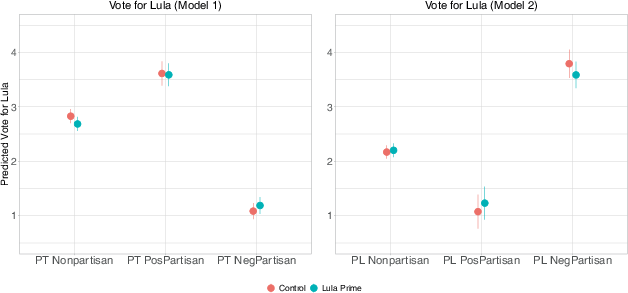
We then examined whether these effects are accentuated by partisanship. We expected that nonpartisans would be more likely to engage in corruption voting than positive or negative partisans. We used an interaction between the corruption treatment and partisanship type to explore this. Fig. 1 shows the predicted values of vote intention for Lula by the Lula corruption treatment condition and partisanship type (full regression models with corresponding statistical information are shown in Tables A4). The color of the points and lines indicates point estimates and 95% confidence intervals for respondents belonging to the Lula corruption treatment (red) or control (blue) group. On the x‑axis of each plot, we display the categories of our two partisanship type variables (PT results in the panel on the left and PL results in the panel on the right), which have three categories each, positive PT (PL) partisan, negative PT (PL) partisan, and nonpartisan of the PT or PL. Positive partisan and negative partisan are shortened to PosPartisan and NegPartisan in the figure.
The two panels show little evidence that the effect of the corruption information treatment varies by partisan type. The left panel reveals that vote intention among positive and negative partisans behaves as expected for both PT and PL. As hypothesized, positive PT partisans and negative PT partisans treated with the corruption treatment voted for Lula similarly to those in the control group (left panel). This finding aligns with prior studies demonstrating that voters are more likely to forgive corruption by politicians from their preferred party (Anduiza et al., 2013; Solaz et al., 2019). Interestingly, among negative partisans of the PT, who are predicted to rarely intend to vote for Lula, those who are treated with information about Lula’s alleged corruption are slightly more likely to intend to vote for Lula, but this difference in effect sizes is neglible and not statistically significant. The right panel reveals that positive and negative partisans of PL experience no significant change in their vote intention for Lula after being exposed to corruption information. Overall, the corruption treatment has little effect on the vote intentions of the positive and negative partisan groups of either party.
We anticipated that the impact of corruption would be most pronounced among nonpartisans. Contrary to our expectations, nonpartisans appear to be just as unresponsive to corruption information about Lula as positive and negative partisans of the PT (left panel) or the PL (right panel). Nonpartisans of the PT treated with a reminder of Lula’s corruption troubles are slightly less likely to vote for Lula than those in the control group, but effect size does not meaningfully decrease and the difference is not statistically significant, and it does not exist for PL nonpartisans.5 Hence, we fail to find support for the notion that nonpartisans are more susceptible to corruption information about Lula.
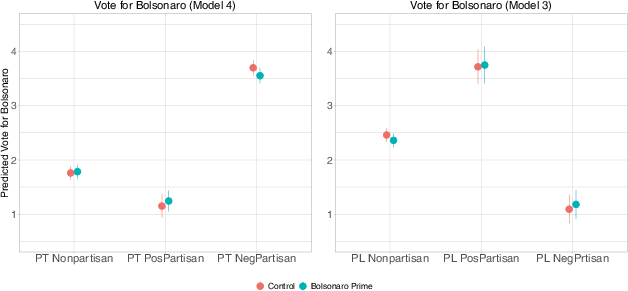
Turning our attention to Bolsonaro, Fig. 2 shows the predicted values of vote intention for Bolsonaro by the Bolsonaro corruption treatment and partisanship type for both PL and PT (left and right panels, respectively). Positive partisan and negative partisan are shortened to PosPartisan and NegPartisan in the figure. Full regression models with corresponding statistical information are in Table A5. Fig. 2 mirrors the previous analysis in Fig. 1 but switches the outcome variable from vote for Lula to vote for Bolsonaro. We find, again, that the corruption treatment barely makes a difference. The similarity of the predicted levels of vote intention between the control and treatment groups remains unchanged for positive, negative, and nonpartisan respondents.
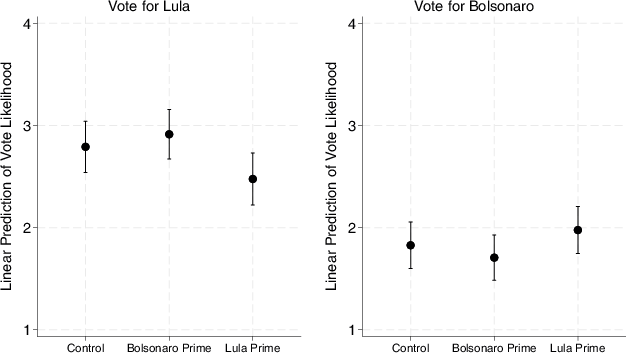
In a final analysis, we explored vote intentions among pure nonpartisans (n = 289), those who do not express a positive or negative attachment to any party, not just the PT or the PL. These indidviduals indicated in the survey that there is no party they identify with, and they also indicated that there is no party they would never support, either. We expected that pure nonpartisans would be most influenced by corruption information due to their complete lack of partisan sympathies or antipathies. Yet, again, the corruption treatment has little impact on pure nonpartisans’ vote intentions (Fig. 3). Related regressions are in Appendix Table A6. Recipients of the Lula treatment have a lower level of vote intention for Lula when compared to the control group, but this decrease in support is only significant at the 0.10 level. This suggests that Lula’s corruption may have a small, negative effect on vote intention among pure nonpartisans, but the decrease in effect size is not large enough to robustly move nonpartisans down into the “unlikely to vote” category. For Bolsonaro, there is little difference in vote intention regardless of the treatment. Pure nonpartisans in the control group have a similar level of support for Bolsonaro as those who received corruption information. Overall, we find little effect of corruption for pure nonpartisans.6
We found no evidence that corruption influences intended vote choice or that the effects of corruption information vary by partisan types. Why? One explanation is that partisanship is simply unrelated to corruption voting. Our null results directly support this interpretation. However, it is important to explore other possible explanations to ensure the null results do not stem from design choices and to better understand the underlying dynamics that may account for the observed patterns. Therefore, we conduct exploratory analyses leveraging a rich set of theoretically relevant pre-treatment questions and test alternative explanations for the absence of treatment effects. This is a key lesson from this study: although researchers often face space constraints when designing survey experiments, incorporating additional related survey questions is important for diagnosing treatment ineffectiveness and providing substantive context for null results.
Our diagnostic analyses lead us to an additional possible explanation for our null results—that candidate preferences and corruption perceptions are so deeply entrenched that new information could not alter vote choice. We first rule out explanations of ceiling effects, second-round election effects, and corruption not being salient in the 2022 election. We then discuss how our design choice of real-world treatments in a highly polarized election environment created a difficult but realistic test for the corruption treatment and provide evidence that candidate corruption perceptions were deeply polarized and tied to voters’ partisanship. We conclude that the null results emerge from voters’ having strong grounded candidate preferences.
A first alternative reason why our corruption treatment did not change voting intentions may be ceiling effects. Ceiling effects occur when respondents’ true attitudes cannot exceed a value with more information (Wang et al., 2009). Observed values are the greatest true values that respondents can actually demonstrate, and empirically, this means that the majority of the data is close to the upper limit (Cramer and Howitt, 2004). In the context of our treatment, Brazilians’ corruption perceptions could have already been so high that there was insufficient space to make them worse. Given how widespread corruption is in Brazil, our treatment might have offered respondents little to learn beyond what they already knew. We can search for evidence of a ceiling effect in our experiment by looking at the baseline levels of corruption perceptions.
Using survey questions about corruption perceptions for Lula, Bolsonaro, and public officials generally, we explored the distribution of responses to see if perceptions were already at the ceiling (see Appendix Table A14). The survey asked respondents “How corrupt do you think ex-President Luiz Inácio Lula da Silva is?” and “How corrupt do you think President Jair Bolsonaro is?” with response options of (1) not corrupt, (2) a little corrupt, (3) corrupt, (4) very corrupt.” We did not find evidence that a majority of respondents approached the upper limit of the corruption scale. The varied distribution of all three perception measures provides evidence against ceiling effects, as many respondents do not express the highest level of corruption for public officials, Lula, and/or Bolsonaro. An ample number of respondents express lower corruption perceptions of Lula and Bolsonaro and therefore could have theoretically been moved by the corruption information in our treatments. We take these data as evidence that a ceiling effect cannot explain our null results.
A related concern could be that voters perceive all candidates as similarly corrupt and thus are unwilling to alter their vote choice because no clean alternative exists. As described above and as shown in Appendix Table A14, our data have variation in respondents’ views of how corrupt different candidates are; thus, this explanation is not directly supported by the data. Viable and clean opposition candidates are critically important for voters to have an alternative to defect to (Elia and Schwindt-Bayer 2022; Vera 2022), and respondents in our survey appear to have perceived such options.
A second possible explanation for our null results is that respondents may have already made up their minds about who to vote for when we conducted the experiment. Studies show that the percentage of undecided voters decreases sharply in the weeks leading up to election day (Eisinga et al., 1998). Our survey was administered two weeks before the runoff, when the campaign was underway and citizens had already cast a first-round vote. Hence, it is likely that a large segment of the electorate had solidified candidate preferences and decided on their vote prior to our survey. Indeed, in our survey, first-round vote choice is highly correlated with our outcome variable of intended vote likelihood (r = 0.85). A reminder of the candidates’ association with corruption may not have been enough to change that vote intention if most people already had a strong preference for a candidate.
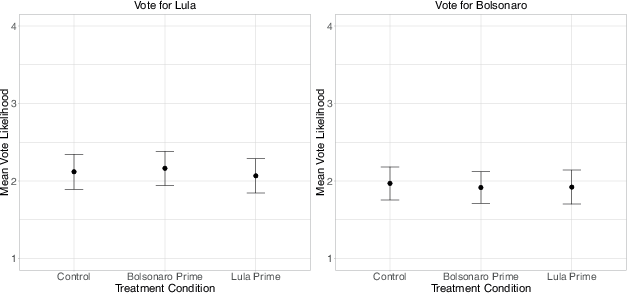
Our survey asked respondents about their first-round vote, and we can surmise that the preferences of respondents who did not vote for Lula or Bolsonaro in the first round were less firmly established and may be more responsive to the corruption treatment. However, we do not find any corruption effects among the 319 respondents (21%) who had not voted for Lula or Bolsonaro in the first round. When subsetting our respondents in this way, the control group consisted of 111 respondents, the Bolsonaro prime group consisted of 107 respondents, and the Lula prime group consisted of 101 respondents. Fig. 4 shows no significant differences in vote likelihood across treatment conditions for these respondents either (regression results are in the Appendix, Table A10). This suggests that second-round voter uncertainties are unlikely to explain the null effect of corruption on vote intention.
A third reason why voters in Brazil may have been unresponsive to the corruption treatment could be that corruption is not an issue that Brazilians incorporated into their voting decisions, particularly in the 2022 presidential race. Even if corruption and crime were prominent issues in previous elections—especially in the 2018 presidential election when Bolsonaro ran on an anti-corruption, law-and-order platform (Renno, 2020)—the saliency of different topics during the 2022 election, such as conservative positions on moral issues or policy plans to tackle economic challenges, may have been more decisive for vote choice. The survey included a pre-treatment open-ended question asking respondents to identify the most important reason behind their intended vote in the second round of the 2022 election. Our analysis found that corruption is mentioned the most out of words describing topics we identified as being linked to vote choice (e.g. economy, abortion, covid, crime, etc.). Table A15 in the appendix shows that words starting with “corrup” are the 12th most frequent word out of all responses and are mentioned 85 times.7 Thus, corruption was in fact key to the votes that people intended to cast.
A fourth explanation is related to the challenges of using real-world treatments. Our null findings could result from our real-world corruption information treatment not having been strong enough to elicit the hypothesized effects. In other words, it may not have provided sufficiently new information in a highly salient and information-rich electoral context with well-known candidates. One tradeoff of using real news stories in a real-world election context within an experiment is that we cannot develop our own treatment text purporting corruption allegations. The news story simply may not have been strong enough to trigger a negative reaction and a lower intended likelihood of voting for the candidate. The corruption information we provided may not have added new information for respondents and may have only reinforced respondents’ priors. Alternatively, motivated reasoning may have led respondents to ignore or downplay the information.
We knew that using real-world candidates made it more likely that our treatment would not move respondents as much as a hypothetical candidate treatment could (McDonald 2020), but we accepted that design tradeoff due to the potential benefit of generating findings that more closely reflect real-world behavior, which is an important goal for all experimental designs. It is undoubtedly important to design survey experiments about corruption that reflect real candidates as much as possible due to the “findings gap” between hypothetical and real-world studies on corruption (Incerti 2020), but our study suggests that scholars of electoral accountability should carefully consider how the use of real candidates in experiments may impact treatment efficacy compared to hypothetical candidates.
A final reason for the null results might be that, even if voters care deeply about the issue of corruption, candidate preferences were so grounded in political identities that our information treatment did not change respondents’ views about the candidates. Partisans often view less corruption among co-partisan politicians or view incumbent co-partisans as better able to combat corruption (Anduiza et al. 2013; Blais et al. 2017; Senters et al. 2018). If candidate corruption perceptions are inextricably tied to partisanship in the Brazilian context, this explanation would also contribute to why our corruption primes were unsuccessful in changing respondents’ vote likelihoods. Corruption and partisanship may be so intertwined that we cannot distinguish their independent effects.
The survey allows us to explore this possibility of grounded voter preferences, and we believe this explanation of our null findings is best supported by our data. The survey included several pre-treatment questions about corruption perceptions of Lula and Bolsonaro. Table 1 displays the cross-tabulations of these corruption perceptions by partisanship. Whereas 129 PT partisans thought Lula was not at all corrupt, no PL partisans did. One hundred fifty-five PL partisans see Lula as very corrupt, however, whereas only 5 PT partisans do. Perceptions are similarly polarized for negative partisans. Only one negative partisan of the PT believed Lula was not at all corrupt whereas 477 PT negative partisans thought he was very corrupt. The majority of PL negative partisans perceived Lula to be not at all or a little corrupt. This extreme pattern exists for Bolsonaro too. These cross-tabulations show how partisanship is highly correlated with corruption perceptions of the candidates. This table also further displays the polarization of candidate corruption perceptions. When corruption perceptions of each candidate are so closely connected to respondents’ partisan identities, new information is unlikely to shift these entrenched preferences.
Table 1 Cross-tabulations of corruption perceptions of Lula and Bolsonaro among PT and PL partisans
Candidate | Corruption perception | PT Positive partisans (n) | PL Positive partisans (n) | PT Negative partisan (n) | PL Negative partisans (n) |
Lula | Not at all corrupt (1) | 129 | 0 | 1 | 95 |
A little corrupt (2) | 85 | 0 | 3 | 83 | |
Somewhat corrupt (3) | 23 | 8 | 27 | 38 | |
Very corrupt (4) | 5 | 155 | 477 | 8 | |
Bolsonaro | Not at all corrupt (1) | 9 | 125 | 316 | 1 |
A little corrupt (2) | 14 | 29 | 103 | 8 | |
Somewhat corrupt (3) | 43 | 4 | 43 | 34 | |
Very corrupt (4) | 187 | 2 | 25 | 192 |
We explore this relationship between perceptions and partisanship further in Fig. 5. We show coefficient estimates for three sets of models that regress PT and PL partisan identities (positive (PT Pos, PL Pos in the figure), negative (PT Neg, PL Neg in the figure), or pure non-partisan which is the baseline category and thus not plotted) on corruption perceptions of Lula and Bolsonaro and on general corruption perceptions with controls for ideology, economic evaluation, interest in politics, sex, age, education, and salary sufficiency. The regression outputs are in Appendix Table A21. Fig. 5 shows that, compared to pure nonpartisans who express no partisan attachments, being a positive partisan of the PT is significantly associated with having a lower corruption perception of Lula and a higher corruption perception of Bolsonaro. The reverse is true for positive partisans of the PL, who are likely to have low corruption perceptions of Bolsonaro but high corruption perceptions of Lula. As expected, negative partisans of the PT (PL) perceive Lula (Bolsonaro) to be very corrupt. In contrast, panel 3 shows no significant associations between any kind of partisanship and general corruption perceptions.
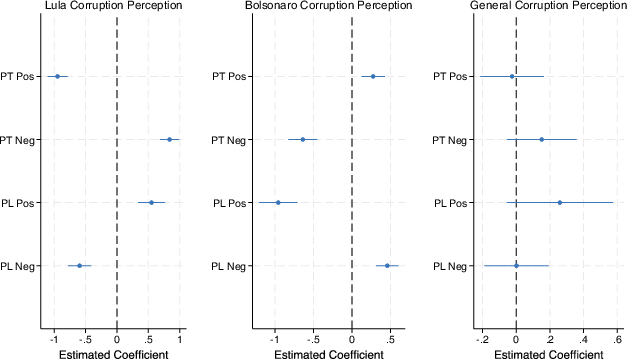
Fig. 5 Coefficient plots of linear regressions of the effect of different types of PT and PL partisanship (baseline = pure nonpartisan) on corruption perceptions, controls included in all models.PT (PL) Pos represents positive partisans of the PT (PL) and PT (PL) Neg represents negative partisans of the PT (PL); regressions shown in Appendix Table A21.
These models showcase that corruption perceptions about each candidate are significantly tied to respondents’ partisanship in a way that is unique from general corruption perceptions, which have no significant relationship to any type of partisanship. The strong connection between candidate corruption perceptions and partisanship reflects strong polarization in the Brazilian election. This may explain why our corruption treatment did not affect people’s votes—their positive or negative partisanship already determined their corruption perceptions of each candidate (or vice versa) and solidified their vote preference. Reminding them of the corruption allegations against the candidate they liked or hated was not going to sway their likelihood of voting for the candidate.
Thus, the power of partisan identities in this election may have contributed to our null findings: partisanship drove most respondents’ vote choices, and so information about corruption did little to influence their vote likelihoods. Partisans were set on voting for their co-partisan candidate, whom they viewed as far less corrupt than the out-party candidate. Respondents’ grounded preferences reflect conclusions from related studies, such as Boas et al. (2019) and Incerti (2020): voters may have norms against corruption in hypothetical settings, but other political preferences take precedence in real-world elections and are often unshakeable, even in the face of corruption information. Our treatment could do little to influence vote likelihood, and the treatment’s potential impact was further weakened due to the fact that corruption perceptions of Lula and Bolsonaro are so strongly related to partisan identity in the first place. Additionally, it is possible that these grounded candidate preferences were present even for voters without partisan attachments to the PT or PL. The 2022 election was so highly polarized, and Lula and Bolsonaro were candidates with such salient reputations, that voters who identified themselves in our survey as nonpartisans may have had strong beliefs regarding the two candidates and their corrupt histories that were difficult to change. Our null effects across all partisan groups may speak to this possibility that respondents who identify as nonpartisans still developed grounded preferences about Lula and Bolsonaro.
This paper aimed to address a significant gap in the literature by highlighting the overlooked role of negative partisanship in corruption voting. However, the preregistered survey experiment yielded unexpected results. While we anticipated heterogeneous treatment effects based on partisanship types, the findings showed that no group—neither positive partisans, negative partisans, nor nonpartisans—applied a significant corruption penalty. Rather than leaving these results unexamined, we sought to diagnose potential sources of the unexpected results. Engaging in such diagnostic analyses is essential to strengthen the interpretability of null findings. This exploratory analysis ruled out several alternative explanations, including ceiling effects, second-round election effects, and low issue salience.
We conclude that the null results reflect respondents’ grounded preferences. The 2022 Brazilian election was highly polarized, featuring two candidates—both previously accused of corruption—competing against each other. In this context, corruption primes had no effect on vote intentions because respondents’ beliefs about Lula’s and Bolsonaro’s corruption were deeply entrenched. Analysis of candidate-specific perceptions confirmed this pattern. We show that views of each candidate’s corruption were highly polarized and aligned with partisan identity. When corruption perceptions are so entrenched, priming corruption cannot meaningfully alter vote intentions. This conclusion emerges from a holistic view of both our original empirical analyses and the exploratory analysis results.
Our study also highlights the trade-offs that researchers face when using real rather than hypothetical candidates in survey experiments on corruption and beyond. Having respondents read real news clippings about Lula and Bolsonaro and express vote intentions of those real candidates in an upcoming election more closely connects our treatment to real-world voting behavior. This enhanced external validity but created an uphill battle for detecting treatment effects. In this context, the firm beliefs that respondents already had about Lula and Bolsonaro’s corruption and their partisanship likely contributed to the ineffectiveness of our treatment. These findings highlight the methodological tension between realism and experimental control that survey researchers must navigate. Realism adds important external validity to survey experiments, which is critical for mapping experimental results to real-world contexts, whether corruption or something else. Yet, it can make it difficult to pick up subtle but important effects that may actually exist in real-world contexts. The trade-off between realistic and hypothetical treatments is something that researchers need to carefully consider in any topical survey experimental study.
Learning from null and unexpected results in survey experiments is essential for refining future research designs. While hypothetical vignettes on sensitive topics like corruption have been criticized for overestimating effects, finding real-world corruption primes strong enough to alter vote intentions for well-known candidates is extremely difficult. To address this issue, conducting pilot studies to pre-test treatment strength can help researchers maximize the realism of real-world scenarios while ensuring the effectiveness of treatments. Additionally, future corruption research should build on these insights by developing alternative experimental designs to further explore the relationship between voter preferences and corruption voting. Future studies could examine the tradeoffs between hypothetical and real-world corruption primes in less polarized settings than our study, whereby less polarization among voters may allow real-world primes to be more effective. Less polarized settings may also reveal greater differences in how nonpartisan respondents engage with corruption information. Similarly, using corruption primes about real candidates who are lesser known than major presidential candidates could allow researchers to treat voters with real-world information that is more novel to voters and less tied to their grounded preferences about very well-known politicians.
Incorporating diagnostic analysis with relevant pre-treatment variables is also crucial for uncovering the mechanisms behind potential null effects. Our exploratory analyses ruled out several alternative explanations for the null effects and demonstrated that perceptions of candidate corruption are too closely tied to partisanship for corruption primes to influence vote intentions. Embedding such diagnostic tools strengthens the interpretability of null findings and contributes to cumulative methodological learning in survey experiments. Survey researchers should more frequently employ such exploratory analyses when they are faced with null findings in their experiments. Ultimately, our findings illustrate how careful examination of null results can contribute to both theory and method in the study of corruption-related political behavior.
Abramowitz, A., & McCoy, J. (2019). United States: Racial resentment, negative partisanship, and polarization in Trump’s America. Annals of the American Academy of Political and Social Science, 681, 137–156. https://doi.org/10.1177/0002716218811309. →
Abramowitz, A., & Webster, S. (2016). The rise of negative partisanship and the nationalization of U.S. elections in the 21st century. Electoral Studies, 41, 12–22. https://doi.org/10.1016/j.electstud.2015.11.001. →
Agerberg, M. (2020). The Lesser Evil? Corruption Voting and the Importance of Clean Alternatives. Comparative Political Studies, 53(2), 253–287. https://doi.org/10.1177/0010414019852697. →
Anduiza, E., Gallego, A., & Muñoz, J. (2013). Turning a blind eye: Experimental evidence of partisan bias in attitudes toward corruption. Comparative Political Studies, 46(12), 1664–1692. https://doi.org/10.1177/0010414013489081. a, b, c, d
Baker, A., Sokhey, A. E., Ames, B., & Renno, L. R. (2016). The Dynamics of Partisan Identification When Party Brands Change: The Case of the Workers Party in Brazil. The Journal of Politics, 78(1), 197–213. https://doi.org/10.1086/683609. →
Blais, A., Gidengil, E., & Kilibarda, A. (2017). Partisanship, Information, and Perceptions of Government Corruption. International Journal of Public Opinion Research, 29(1), 95–110. https://doi.org/10.1093/ijpor/edv037. →
Boas, T. C., Hidalgo, F. D., & Melo, M. A. (2019). Norms versus action: Why voters fail to sanction malfeasance in Brazil. American Journal of Political Science, 63(2), 385–400. a, b, c, d
Cramer, D., & Howitt, D. L. (2004). The SAGE dictionary of statistics: A practical resource for students in social sciences. London: SAGE Publications Ltd.https://doi.org/10.4135/9780857020123 →
Dunning, T., Grossman, G., Humphreys, M., HydDunning, T., Grossman, G., Humphreys, M., Hyde, S. D., McIntosh, C., Nellis, G., Adida, C. L., Arias, E., Bicalho, C., Boas, T. C., Buntaine, M. T., Chauchard, S., Chowdhury, A., Gottlieb, J., Hidalgo, F. D., Holmlund, M., Jablonski, R., Kramon, E., Larreguy, H., … Sircar, N. (2019). Voter Information Campaigns and Political Accountability: Cumulative Findings from a Preregistered Meta-Analysis of Coordinated Trials. Science Advances, 5(7), eaaw2612. https://doi.org/10.1126/sciadv.aaw2612. →
Ecker, A., Glinitzer, K., & Meyer, T. M. (2015). Corruption performance voting and the electoral context. European Political Science Review, 8(3), 333–354. https://doi.org/10.1017/S1755773915000053. →
Eggers, A. (2014). Partisanship and Electoral Accountability: Evidence from the UK Expenses Scandal. Quarterly Journal of Political Science, 9(4), 441–472. →
Eisinga, R., Franses, P. H., & van Dijk, D. (1998). Timing of Vote Decision in First and Second Order Dutch Elections 1978–1995: Evidence from Artificial Neural Networks. Political Analysis, 7, 117–142. →
Elia, E., & Schwindt-Bayer, L. A. (2022). Corruption perceptions, opposition parties, and reelecting incumbents in Latin America. Electoral Studies, 80, 102545. https://doi.org/10.1016/j.electstud.2022.102545. a, b
Elia, E., Schwindt-Bayer, L. A., & Vera, S. (2026). “Replication Data for: Corruption, Partisanship, and Voting: Lessons from a Survey Experiment during the Brazilian Presidential Election”. Harvard Dataverse. https://doi.org/10.7910/DVN/OS3CXZ. a, b
Gidron, N., Adams, J., & Horne, W. (2019). Toward a Comparative Research Agenda on Affective Polarization in Mass Publics. https://papers.ssrn.com/sol3/papers.cfm?abstract_id=3391062 →
Gonzalez-Ocantos, E. A., Chirinos, P. M., Muñoz, P., Pavão, N., & Hidalgo, V. B. (2023). Prosecutors, Voters and The Criminalization of Corruption in Latin America: The Case of Lava Jato. Cambridge University Press. →
Haime, A., & Cantú, F. (2022). Negative Partisanship in Latin America. Latin American Politics and Society, 64(1), 72–92. https://doi.org/10.1017/lap.2021.54. a, b
Harrison, C. (2022). Explainer: Brazil’s 2022 General Election. AS/COA. https://www.as-coa.org/articles/explainer-brazils-2022-general-election →
Incerti, T. (2020). Corruption Information and Vote Share: A Meta-Analysis and Lessons for Experimental Design. American Political Science Review, 114(3), 761–774. https://doi.org/10.1017/S000305542000012X. a, b, c, d
Klašnja, M. (2017). Uninformed Voters and Corrupt Politicians. American Politics Research, 45(2), 256–279. a, b
Klašnja, M., & Tucker, J. A. (2013). The economy, corruption, and the vote: Evidence from experiments in Sweden and Moldova. Electoral Studies, 32(3), 536–543. →
Klašnja, M., Lupu, N., & Tucker, J.A. (2021). When Do Voters Sanction Corrupt Politicians? Journal of Experimental Political Science, 8(2), 161–171. →
Lee, A. H. Y., Lelkes, Y., Hawkins, C. B., & Theodoridis, A. G. (2022). Negative partisanship is not more prevalent than positive partisanship. Nature Human Behaviour, 6(7), 951–963. https://doi.org/10.1038/s41562-022-01348-0. →
McDonald, J. (2020). Avoiding the Hypothetical: Why “Mirror Experiments” are an Essential Part of Survey Research. International Journal of Public Opinion Research, 32(2), 266–283. https://doi.org/10.1093/ijpor/edz027. a, b, c, d
Medeiros, N., & Noel, A. (2014). The Forgotten Side of Partisanship: Negative Party Identification in Four Anglo-American Democracies. Comparative Political Studies 47(7), 1022–1046. https://doi.org/10.1177/0010414013488560. →
Pavão, N. (2018). Corruption as the Only Option: The Limits to Electoral Accountability. The Journal of Politics, 80(3), 996–1010. https://doi.org/10.1086/697954. →
Przeworski, A., Stokes, S. C., & Manin, B. (1999). Democracy, accountability, and representation. Vol. 2. Cambridge University Press. →
Renno, L. (2020). The Bolsonaro Voter: Issue Positions and Vote Choice in the 2018 Brazilian Presidential Elections. Latin American Politics and Society. https://doi.org/10.1017/lap.2020.13. a, b
Samuels, D., & Zucco, C. (2018). Partisans, Antipartisans, and Nonpartisans: Voting Behavior in Brazil a, b, c
Senters, K., Weitz-Shapiro, R., & Winters, M. S. (2018). Continuity and change in public attitudes toward corruption. Routledge Handbook of Brazilian Politics. Routledge, 15-38. →
Solaz, H., De Vries, C. E., & de Geus, R. A. (2019). In-Group Loyalty and the Punishment of Corruption. Comparative Political Studies, 52(6), 896–926. https://doi.org/10.1177/0010414018797951. a, b, c
Stuenkel, O. (2021). Brazil’s Polarization and Democratic Risks—Divisive Politics and Democratic Dangers in Latin America. Carnegie Endowment for International Peace. https://carnegieendowment.org/2021/02/17/brazil-s-polarization-and-democratic-risks-pub-83783 →
Vera, S. B. (2022). How does clarity of alternatives affect the electoral fortune of corrupt politicians? Electoral Studies, 77, 102476. https://doi.org/10.1016/j.electstud.2022.102476. a, b
Wagner, M. (2021). Affective polarization in multiparty systems. Electoral Studies, 69, 102199. https://doi.org/10.1016/j.electstud.2020.102199. →
Wang, L., Zhang, Z., McArdle, J. J., & Salthouse, T. A. (2009). Investigating Ceiling Effects in Longitudinal Data Analysis. Multivariate Behavioral Research, 43(3), 476–496. https://doi.org/10.1080/00273170802285941. →
Winters, M. S., & Weitz-Shapiro, R. (2018). Information credibility and responses to corruption: A replication and extension in Argentina. Political Science Research and Methods, 8(1), 169–177. https://doi.org/10.1017/psrm.2018.50. →