Surveying Minoritized Citizens: A Quantitative Study of Identification Versus Categorization
833410.18148/srm/2026.v20i1.8334Surveying Minoritized Citizens: A Quantitative Study of Identification Versus Categorization
Sanne
van Oosten sanne.vanoosten@compas.ox.ac.uk University of OxfordOxfordUnited Kingdom
1172026European Survey Research Association
Survey research on minoritized citizens tends to categorize respondents from the top down, instead of allowing for identification from the bottom up. I surveyed 1864 respondents in Germany and the Netherlands, including 401 respondents with a background in Türkiye. I find that those who identify as Turkish often hold significantly different attitudes than those who have a background in Türkiye but who identify as German or Dutch. In fact, those who do not identify as Turkish, hold significantly different attitudes than when a researcher would categorize them as “having a migration background” and/or as “having a migration background in Türkiye.” I provide proof of this with attitudes towards topics often associated with citizens with a migration background. Beyond these empirical advantages to identification over categorization, this paper outlines additional theoretical, methodological and conceptual advantages to following an identification approach in designing surveys.
1 Introduction
Survey researchers in Germany and the Netherlands often rely on the demographic category migration background to capture racial/ethnic differences (Bialas et al., 2024; Borrelli and Ruedin, 2024; Coenders, 2024; James et al., 2024; Rosen and Jacob, 2022; Türkmen, 2024; Will, 2019, 2024). Yet this top-down categorization does not capture whether respondents identify with the group they are assigned to from the bottom up (Geurts et al., 2021; de Jong and Duyvendak, 2023; Slootman 2016, 2018, 2019). This paper addresses a methodological question in survey design: What are the advantages and disadvantages of measuring identification rather than categorization using migration background?
Measuring identification is fairly straightforward. The simple survey questions used in this study reveal that it does not have to be any more complicated than measuring migration background. The European Social Survey (ESS, 2020, 27) also includes questions on identification in their surveys. However, the ESS does not currently incorporate an oversampling strategy for racial/ethnic minority respondents, an indispensable practice when analyzing racial/ethnic minority respondents’ attitudes. Surveys that do, however, oversample racial/ethnic minority respondents, such as the German Socio-Economic Panel (SOEP) of the Deutsches Institut für Wirtschaftsforschung (DIW) or the Online Access Panel of the German Center for Integration and Migration Research (DeZIM), do not ask the same questions about identification suggested in this paper. The paper at hand presents both identification measures and oversampling techniques at the same time.
The sampling process reached 1859 respondents of which 1358 have a migration background in Türkiye (401 respondents), Former Soviet Union, Morocco and Surinam, enough for statistical analyses. Their migration background was measured by asking where their mother and father were born. This paper focusses on German and Dutch citizens with a migration background in Türkiye because this is the most numerous racial/ethnic minority group and the only common category, in both countries. After measuring how respondents are categorized from the top down, they were asked attitude questions followed by questions about how they identify from the bottom up. Respondents could indicate identifying with one or two national, racial/ethnic groups and this paper presents analyses of respondents who identify as Turkish, German/Dutch or both.
Finally, this paper presents respondents’ attitudes towards three topics that citizens with a migration background are said to be different in: belonging, Islam and sexuality. The most important empirical contribution is that citizens with a migration background in Türkiye, who do not identify as Turkish, differ in their attitudes to both Turkish identifiers as well as those with a migration background in Türkiye, while they rarely differ from German or Dutch citizens without a migration background. The empirical insights garnered from this investigation underscore the need for a new approach to studying racial/ethnic minority groups in survey research, and strengthen the discussion on advantages and disadvantages of measuring racial/ethnic identification rather than categorization using migration background. The conclusion is that including survey questions on identification is a fruitful avenue for achieving a more accurate understanding of racial/ethnic minority group attitudes and experiences.
2 Theory
Lee’s (2008) canonical article on the “identity-to-politics link” criticizes the common practice of lumping together a shared demographic categories and presuming “groupism” to flow from it (2008: 461). Instead, he proposes that the link between demographic categories to social attitudes is a series of connections, which he terms the “identity-to-politics link” (idem). The first step in this “nexus” lies in the definition of the group in question (2008: 466). In the case of Germany and the Netherlands, those who are referred to as having a migration background and counted as such if either parent was born in a different, often only deemed relevant if non-western, country (Bloemraad, 2013: 657; Elrick and Schwartzman, 2015: 1543). The second step is “identification”, do citizens categorized as having a migration background also identify with that category? Indeed, “the mere existence of categories does not guarantee that the individuals to whom they are meant to apply will identify with them” (Lee, 2008: 467). Step three questions whether individuals who identify with their group share political interests or beliefs. Do citizens who identify as Turkish hold different attitudes than citizens with a migration background in Türkiye who do not identify as such?
This paper focusses on these first three steps of the “identity to politics”-link. This theoretical framework discusses these first three steps in this order. First, how the category migration background was incorporated in official national statistics and survey research and what the criticisms are of this category. Second, a conceptualization of “identification” as active, possibly pertaining to multiple identifications at the same time and from the bottom up whilst in dialogue with categorizations from the top down. Third, how identification groups differ from one another in their political attitudes in Germany and the Netherlands.
The term migration background has not always been the way in which German and Dutch statistics bureaus termed racial/ethnic minority individuals living in their country. As former guest workers and other immigrants were becoming a sustained presence in these societies and were steadily gaining German and Dutch citizenship, the terms “immigrant”, “Ausländer” or “allochtoon” were more and more outdated and both societies officially chose to use the term migration background in their official statistics (CBS, 2005, 2016; Elrick and Schwartzman, 2015). One is defined as having a migration background if they or either one of their parents were born in another country, with the Netherlands officially distinguishing between western and non-western countries initially (Coenders, 2024) though they let go of that distinction recently.1 In 2022, the Dutch statistics bureau announced a new definition and terminology: they now call someone a “migrant” if they are born in a different country, if only one or two parents are born in a different country they are a “child of a migrant.”2 However, this new definition and terminology has not caught on yet, neither in public discourse,34 nor in publications from the Dutch statistics bureau itself.56 When the Dutch statistics bureau does use the new terminology,7 the state news broadcaster (NOS) still uses the term migration background.8
Whereas statistics bureaus initially assumed that the label migration background would remain relevant for no more than two generations and defined it as such (Amelung et al., 2024; James et al., 2024; Türkmen, 2024), in Germany and the Netherlands, third-generation children with a migration background in Türkiye are approaching adulthood and national statistics bureaus need a new definition. Extending migration background into the third generation could provide a continuing “temporally comparable” variable (Bovens et al., 2016: 39; Ham and van der Meer, 2012), but the increasingly pertinent question is whether the label is psychologically relevant to all members of the category. Bottom-up identification has the advantage of built-in relevance: if one’s migration background is relevant to the individual, it is potentially relevant to research and policy. This is the conceptual advantage to bottom-up identification.
Both Germany and the Netherlands have seen new arrivals of immigrants since the Second World War, most numerously guest workers from Türkiye (Ersanilli and Saharso, 2011). Despite having slightly different integration policies in the past, integration policies are converging (Joppke, 2007) and this does not seem to have played a role in the racial/ethnic identification of second generation children of Turkish descent (Ersanilli and Saharso, 2011). Two important differences between Germany and the Netherlands, however, are very relevant to the study of Turkish identification: the presence of Populist Radical Right Parties (PRRP). PRRPs and their accompanying anti-immigrant and stigmatizing rhetoric have been present longer, and arguably more virulently, in the Netherlands than Germany (Althof, 2018; Sipma et al., 2021; van Oosten, 2025: 12–14). The anti-immigrant and stigmatizing rhetoric espoused by PRRPs can move citizens with a migration background to identify “reactively”, even those who are deemed “integrated” in a socio-cultural and economic sense and lack strong ties with the country their parents were born in (Slootman and Duyvendak, 2015: 160). Identifying more strongly with their country of descent can function as a “de-stigmatisation strategy” (de Jong and Duyvendak, 2023).
Besides being exposed to PRRP exclusionary integration rhetoric, experiences with discrimination increase racial/ethnic identification (Fleischmann et al., 2019). Especially racial/ethnic minority social mobility climbers (Slootman, 2016, 2018, 2019) report “experiences of exclusion that accompany their socioeconomic advancement” (Slootman, 2019: 854). Again, Dutch citizens with a migration background in Türkiye experience much more discrimination than their German counterparts. In fact, Dutch citizens with a background in Türkiye experience the highest levels of discrimination in Europe (FRA: European Union Agency for Fundamental Rights, 2017: 31). Far fewer German citizens from Türkiye experience discrimination in the previous 12 months (18% in Germany versus 39% in the Netherlands). Thus, although Germany and the Netherlands are very similar in many regards, the presence of anti-immigrant rhetoric is more established (van Oosten, 2025: 12–14) and discrimination is more prevalent in the Netherlands, making higher Turkish identification more likely in the Netherlands than in Germany.
Although levels of identification may differ in Germany and the Netherlands, the expectation that identification-groups will differ in their attitudes in very similar ways in both countries. This paper provides proof of concept by comparing the attitudes of three different identification groups amongst German and Dutch survey respondents with a migration background in Türkiye: those who only identify as Turkish, who identify as both Turkish and German/Dutch and those who only identify as German/Dutch. Comparing how they differ in their attitudes shows differences in three topics associated with racial/ethnic minorities: 1) whether they feel accepted as belonging in the country they live in (Slootman and Duyvendak, 2015; Ocampo, 2024; Yuval-Davis, 2011), 2) whether they think Islam should (not) be restricted by law (Fleischmann and Phalet, 2018; van Oosten, 2024) and 3) whether same-sex couples should be allowed to adopt children (Puar, 2013, 2015; Soehl, 2017; van Oosten, 2022).
First, this paper understands belonging as whether you feel “at home” in the context you live in (Yuval-Davis, 2011: 35). This can be both a cause or a consequence of identification: either those who identify as Turkish feel less at home because they themselves retreat from the host society, or those with a migration background in Türkiye who do not feel accepted as belonging are more likely to identify as Turkish (i.e. Ocampo, 2024). Either way: the expectation is that the three identification groups score very differently in terms of whether they feel accepted as belonging.
Second, many citizens with a migration background in Türkiye are Muslim and the expectation is that the three identification groups will score differently in their attitudes towards Islam because racial/ethnic and religious identification are highly correlated (Fleischmann and Phalet, 2018). That means that those who identify as Turkish should be more opposed to restricting Islam by law than those who do not identify as Turkish, with people who identify as both Turkish and Dutch taking up an intermediary position. Here, too, the causality could run in various directions: either Muslim citizens with a migration background in Türkiye are both more likely to identify as Turkish and be in favor of Muslim rights, or Turkish identifiers are more likely to have strong connections with the Turkish community through practicing their Muslim faith and are therefore more likely to be in favor of Muslim rights. This paper also explores the causal links between, categorization, identification and attitudes.
Third, the literature on homonationalism postulates that cultural others are deemed undesirable due to their views on gay rights (Puar, 2013, 2015; van Oosten, 2022). Even though citizens with a migration background do indeed hold more conservative values towards sexuality (Soehl, 2017), the expectation is not that this holds equally for the three groups of identifiers. This paper aims to demonstrate that the three identification-groups indeed hold different attitudes towards adoption by parents of the same sex. Showing how the three groups of identifiers (Turkish and German/Dutch) differ in their attitudes provides empirical support for measuring identification from the bottom-up instead of categorizing survey respondents from the top-down.
3 Methods
In order to uncover differences within the category migration background, this study oversamples German and Dutch citizens with the most common migration backgrounds who experience the most discrimination (FRA, 2017). Leading to an oversample of citizens considered culturally different from the majority population: citizens with a migration background in Türkiye and the Former Soviet Union in Germany and in the Netherlands citizens with a migration background in Türkiye, Morocco and Surinam. This paper focusses on the identification patterns of German/Dutch survey respondents with a migration background in Türkiye because this is the largest racial/minority group, they experience high levels of discrimination, Türkiye is the only common migration background in both countries and they also arrived in either country under similar circumstances. Most came to Germany and the Netherlands starting in the sixties and seventies as guest workers (Fleischmann and Phalet, 2012: 325; Yurdakul, 2009).
The data for this paper is based on a survey conducted between March and June 2020, administered by survey agency Kantar Public. After obtaining the appropriate ethical consent (van Oosten et al. 2024a: 21, 2024b: 20), survey data was collected amongst 1859 German/Dutch-speaking survey respondents of Germany and the Netherlands. The sampling strategy as reported by Kantar is available (see van Oosten et al., 2024a: 13, 2024b: 12).9
The fieldwork in Germany ran from June 22 to July 14, 2020. The target groups in Germany were Germans with both parents born in Germany, Germans with either parent born in the former Soviet Union and Türkiye. Kantar Public selects respondents from both Kantar Profiles as well as Lucid, Bilendi and Toluna, all four are survey companies to which respondents can sign up themselves, without being recruited specifically by the survey company. The recruitment methods are diverse (van Oosten et al., 2024a: 13), but all boil down to various forms of self-selection. There are distinct disadvantages to self-selection in survey research, the most important being that it causes selection bias on unknown properties (Bethlehem, 2010). The concern for self-selection is exacerbated by the fact that, in Germany, Kantar Public uses a portal-driven system in which respondents can browse an array of survey topics and choose one that interests them. Most survey companies invite their respondents to a survey via an email, arguably creating not only a selection bias in who receives an email, but also creating selection bias in who responds to (which) email. If they are prone to answering emails from survey companies, they will respond, if not, they will not. In the German data-collection, some respondents enter the portal via an invite to an email, but some just browse the portal on their own initiative. Once in the portal, several surveys are presented to the respondents and the respondents can choose which survey to engage in, creating another a further opportunity for selection bias. On a whole, the sampling design creates moments of self-selection in various point along the line from joining the panel to commencing the survey, making the risk of self-selection larger compared to the data collection in the Netherlands.
Oversampling respondents with a migration background poses specific challenges, as Kantar Profiles, Lucid, Bilendi and Toluna do not save information on respondent migration background. The current study overcame this challenge by employing a large-scale filter question in the German data-collection and asking a very large sample of respondents to participate in a mini-survey. The first and only questions of this mini-survey asks where their mother and father were born. If either one of their parents were born in a country of interest, Kantar redirected this respondent to the full survey. If not, they either terminated the survey or redirected a small percentage to the full survey. This enabled us to form sizable groups of minority respondents for our final survey, ensuring ample diversity, a feature so often missing from survey research (Coppock and McClellan, 2018), but also imperative to oversampling racial/ethnic minority respondents. Because migration backgrounds were unknown in advance, small batches of survey invitations were sent out daily and Kantar Public monitored quota fulfillment. Because some respondents joined the portal on their own initiative, i.e. without having received an email invitation first, overall response-rates cannot be reported. Kantar Profiles successfully engaged 11,872 panelists to participate in the study. Of these, 10,443 were screened out after the large-scale filter question on parental migration background because their target group quotas were already full, 88% of the sample. The success rate, or net response, was 8%, with a total of 954 completed surveys. The drop-out rate during the German fieldwork was 4%, meaning that 475 respondents started the questionnaire but did not complete it.
The fieldwork in the Netherlands was designed to be as similar as possible, but there were still some important differences. It ran from March 12 to May 15, 2020. In the Netherlands, Kantar Public used the NIPObase panel, which includes approximately 105,000 respondents from 57,000 households. Recruitment for NIPObase is exclusively initiated by Kantar Public using personal data from government-commissioned research. When the Dutch government asks Kantar Public to conduct research on their behalf, Kantar Public is allowed to make use of the official national population registry, a prerogative rarely available for survey researchers in the Netherlands. Because it is rare that any researchers in the Netherlands have access to the full sampling frame of the Dutch population, survey researchers usually need to rely self-selection, where it is completely left to the respondent whether they are part of a survey (Bethlehem, 2010), such as in the German data-collection. Such self-selection comes with serious problems of selection bias (idem). The strategy of Kantar Public in the Netherlands represents the middle ground between having a complete sampling frame to sample from, a prerogative rarely available for survey researchers, and self-selection, with its inherent problems of selection bias. Kantar Public’s strategy is as follows: After they finish conducting the research commissioned by the government, for which they used the complete sampling frame with national population statistics, they asked respondents whether they would be willing to be contacted for other research as well. Kantar Public specifically asks respondents to join the NIPObase when they have a key demographic variable the NIPObase panel lacks, such as gender, age, education, Nielsen region, and urbanization. Though whether a respondent answers that question with yes or no is a form of selection bias, the bias is arguably not as great as when selection is completely left to the initiative of the respondent. Compared to complete self-selection, this strategy is more likely to ensure a fair distribution across demographic variables and minimize professional respondents.10
For respondents to join the NIPObase, they need to fill out whether they have a migration background. This means that Kantar Public does not have to employ a large-scale filter question to ensure filling the quota of migration backgrounds we requested, they could specifically send out more emails to respondents with a migration background in the countries of interest. In total, the response rate in the Netherlands was 54%. For this study, the total drop-out rate was 10%, meaning that 10% of respondents who started the questionnaire did not complete it. A reminder was sent out on March 30, 2020, to encourage participation. In total, 36% of the respondents did not reply to the invitation. The study targeted four main racial/ethnic minority groups in the Netherlands: Dutch respondents without a migration background, a migration background in Morocco, Türkiye and Surinam. The response-rate differed between the different groups: for Dutch respondents without a migration background the response-rate was 67 %, for those with a background in Morocco 39 %, Türkiye 42 % and Surinam 64 % (see van Oosten et al., 2024b: 13). Although migration background data is available in NIPObase, respondents were also asked about their parents’ country of birth to confirm their background and to have asked the exact same questions in Germany as in the Netherlands.
In sum, the recruitment process differed between the two countries. In the Netherlands, respondents were recruited through the NIPObase panel, which is made up of respondents who were approached after government-initiated research with the population registry as a sampling frame and who were interested in receiving more requests to participate in research, and received a personal email invitation. In Germany, respondents were recruited through Kantar Profiles and partner panels (Lucid, Bilendi, and Toluna), using a portal-driven system where they could check for available surveys rather than receiving personal invitations. The Dutch panel had a drop-out rate of 10%, whereas Germany had a lower drop-out rate of 4%. Migration background data in the Netherlands was already known within NIPObase but was confirmed in the questionnaire, while in Germany, it was determined solely through survey responses. Dutch respondents received reminders, boosting participation, whereas German respondents did not receive reminders, and quotas were monitored daily to adjust invitation distribution. The differences in sampling strategy did not lead to any major differences in the conclusions, as shown in subgroup analyses integrated into Figs. 1, 2, 3 and 4 with scores shown for subgroups varying by country, gender and level of education. Generally, respondents who identify as Turkish have significantly different attitudes than respondents with a migration background in Türkiye who do not identify as Turkish and the latter’s attitudes to not differ from respondents without a migration background. The full sampling strategy as reported by Kantar, as well as a reference number to receive additional information is available with the online dataset and codebook on Harvard Dataverse (van Oosten et al., 2024a, b) as well as above.

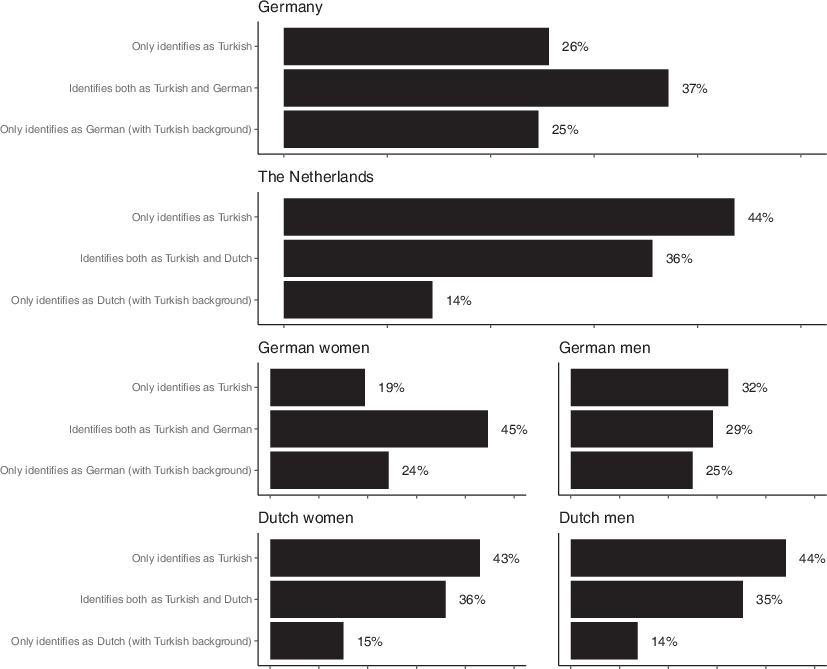
Fig. 1 Identification amongst German and Dutch respondents with a background in Türkiye. Respondents were asked: ‘In terms of my ethnic group, I consider myself to be.(max. 2 answers)’ presented respondents a long list of 10 (Germany) or 13 (Netherlands) possible answer categories. Respondents were able to rank each ethnic group as 1 or 2, or indicate that both groups are equally important. The percentages do not add up to 100 because some respondents with a background in Türkiye identify with other groups. Appendix 2 shows that very small percentages of those who do not identify as Turkish or German/Dutch identify as Alevi and Kurdish, among other groups (see Appendix 2: https://doi.org/10.17605/OSF.IO/CXMDH).

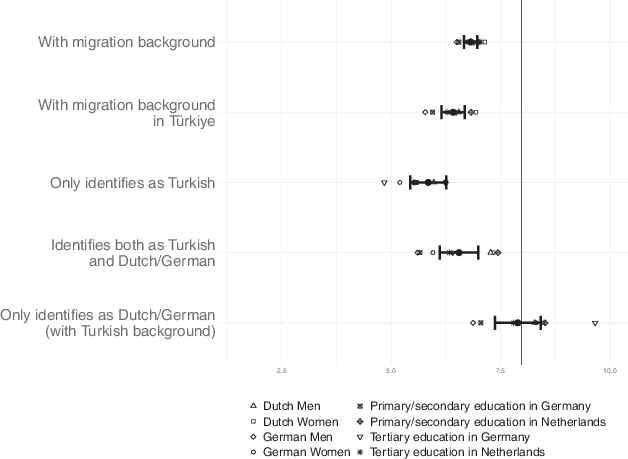
Fig. 2 Mean scores with 95 % confidence intervals from German and Dutch respondents to the question “Do you feel generally accepted as belonging to the country you live in?” ranging from “not at all” (0) to “completely” (10). Subgroup scores indicated without confidence intervals, symbols in legend. Black line indicates mean score for respondents without a migration background.

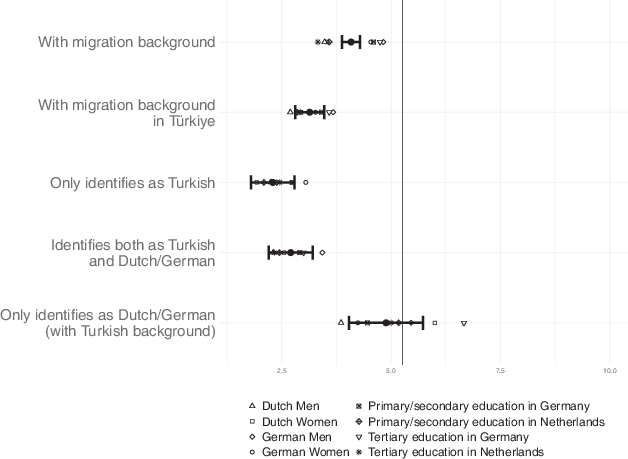
Fig. 3 Mean scores with 95 % confidence intervals from German and Dutch respondents for the statement “Islam should be restricted by law” ranging from “disagree” (0) or “agree” (10). Subgroup scores indicated without confidence intervals, symbols in legend. Black line indicates mean score for respondents without a migration background.

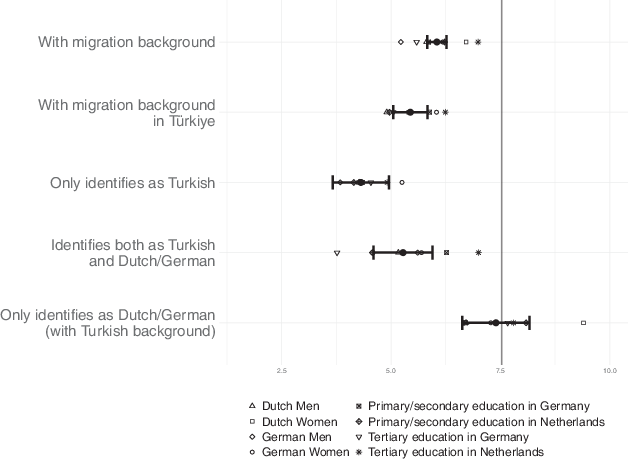
Fig. 4 Mean scores with 95 % confidence intervals from German and Dutch respondents for the statement “Homosexual couples should be allowed to adopt children” ranging from “disagree” (0) or “agree” (10). Coefficients returned from linear regression model. Subgroup scores indicated without confidence intervals, symbols in legend. Black line indicates mean score for respondents without a migration background.
Table 1 shows the number of respondents in each group and other characteristics of the sample. The respondents with a background in Türkiye were younger than those without a migration background, as well as more highly urbanized, which is in line with characteristics of the populations (CBS, 2021; Destatis, 2025). However, Dutch respondents with a background in Türkiye were slightly more often graduates of tertiary education, which is not what is to be expected based on population characteristics (CBS, 2021). Moreover, this study’s data collection does not qualify as probability sampling, as the sampling probabilities cannot be determined (Kohler, 2019: 1).
Table 1 Characteristics of the sample.
| N Respondents | Mean Age | Women (%) | Tertiary Education (%) | Highly Urbanized Area (%) |
Respondents with a migration background in countries other than Türkiye primarily originate from the Former Soviet Union (Germany) and Morocco or Suriname (the Netherlands). These are the most common migration backgrounds in Germany and the Netherlands, aside from Türkiye. ‘High Urbanization’ represents the percentage of respondents living in highly urbanized areas (more than 2500 addresses per km2) |
Netherlands No migration background | 308 | 54 | 52 | 12 | 19 |
Netherlands Background in Türkiye | 202 | 40 | 50 | 13 | 43 |
Netherlands Background in other country | 410 | 46 | 58 | 15 | 48 |
Germany No migration background | 346 | 48 | 51 | 26 | 31 |
Germany Background in Türkiye | 199 | 34 | 52 | 21 | 48 |
Germany Background in other country | 547 | 42 | 61 | 30 | 33 |
Stratified random sampling is “practically impossible” (Kohler, 2019: 8), making stratified nonprobability sampling a second-best solution (idem). There is not a way to know if the effects shown in Fig. 1, 2, 3, 4 and 5 are homogenous in the population, we can only assume it, which is why subgroup analyses are a third-best solution (idem). With these subgroup analyses, I have aimed to demonstrate the robustness of the findings in this paper, see Figs. 1, 2, 3 and 4. I reran all the analyses for different subsets of the population to show that the results are still largely consistent suggesting that selection bias favoring certain subsets of the population should not influence the overall results. When results are not consistent, this is discussed explicitly in the text. This exemplifies the robustness of the results despite not reaching probility sampling nor homogeneity (Kohler, 2019). All subsets and models lead to the same conclusion: among respondents with a migration background in Türkiye, those who do not identify as Turkish exhibit different attitudes compared to those who do, with those who identify as German or Dutch being generally closer to the reference category of respondents without a migration background.

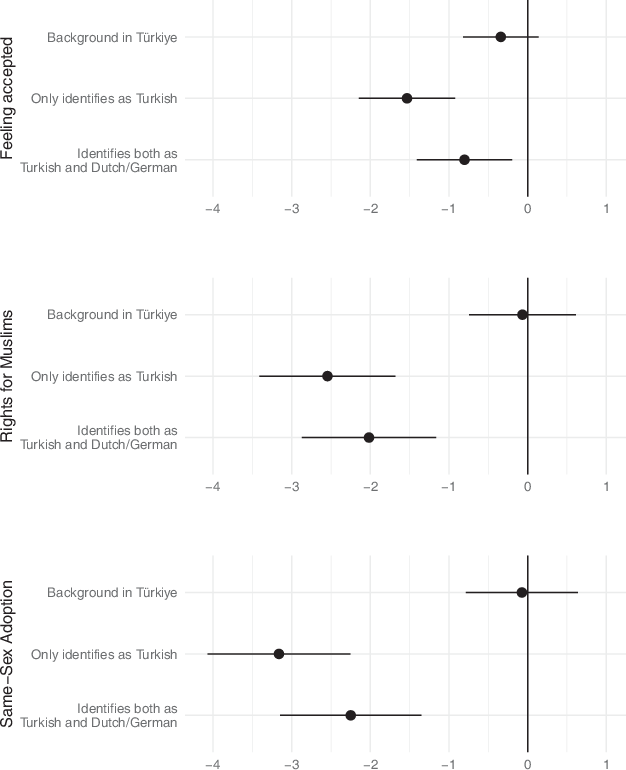
Fig. 5 Reactions from German and Dutch respondents to the question “Do you feel generally accepted as belonging to the country you live in?” ranging from “not at all” (0) to “completely” (10) (model 1), “Islam should be restricted by law” ranging from “disagree” (0) or “agree” (10) (model 2), “Homosexual couples should be allowed to adopt children” ranging from “disagree” (0) or “agree” (10) (model 3). Coefficients returned from linear regression model. Error bars represent the 95% confidence interval. Control variables: education, age, sex, work situation, income and urbanization and other migration backgrounds besides Turkish—Former Soviet Union (Germany), Surinam, and Morocco (Netherlands). For all models, reference categories consist of respondents without a migration background.
The three attitudes used to provide proof of concept were measured on an 11-point scale ranging from 0 to 10. The first question was: “Do you feel generally accepted as belonging to the country you live in?” (phrasing own) ranging from “not at all” (0) to “completely” (10). The second and third questions were whether respondents “disagree” (0) or “agree” (10) with the statement “Islam should be restricted by law” (phrasing own) and “Homosexual couples should be allowed to adopt children” (phrasing borrowed from VAA, 2017). For all survey questions, see Appendix 1.
In all models, respondents without a migration background serve as a reference category. The data was prepared using R‑package “tidyr” (Wickham, 2020) and visualized with “ggplot2” (Wickham et al., 2020). The linear models with identification (dummy) variables used respondents without a migration background as a reference category throughout the models. Hypothesis tests were accepted with a p-value of smaller than 0.05. For all analyses, see code.11
The analyses compare measures of top-down categorization with measures of bottom-up identification by comparing marginal means (Figs. 2, 3 and 4) and running simple linear regression models while controlling for gender, age, education, employment, income and urbanization (Fig. 5). The first top-down category is migration background and includes all respondents of which either or both parents were born in any other country besides Germany or the Netherlands: Former Soviet Union, Morocco, Surinam or any other country. This was measured by asking “where was your mother born” and “where was your father born”. The second top-down category is “migration background in Türkiye” which only includes the respondents of which either or both parents were born in Türkiye.
These top-down categorizations are compared with bottom-up identification. The survey asks respondents: “In terms of my ethnic group, I consider myself to be … (max. 2 answers)”. The respondents read a list of 10 (Germany) or 13 (Netherlands) possible answer categories. Respondents were allowed to give one or two answers (for a full overview of all the answers given, see appendix 2). Within the category migration background in Türkiye, only few respondents identified as Kurdish. The respondents either identifies as 1) only Turkish, 2) both Turkish and German/Dutch or 3) only German/Dutch.
I argue there are some methodological advantages to measuring identification over categorization that survey researchers can benefit from. As a researcher, one only needs to ask about how the respondents themselves identify, instead of asking about parents’ birthplace which they might not deem relevant to their lives. To respondents, identification questions are, therefore, less intrusive. In addition, many respondents are aware of the negative connotations their migration background might convey (Elrick and Schwartzman, 2015: 1548), making questions on parental migration background possibly demeaning or infuriating. In fact, during qualitative testing of this survey several respondents commented on feeling seen and heard by the questions on identification (anecdotal evidence). As social research relies increasingly on survey companies with panels of respondents who respond to surveys on a regular basis (Coppock and McClellan, 2018), survey companies are careful not to ask questions that might anger respondents/provoke negative responses. Besides these methodological advantages to identification over categorization-measures, there are also methodological disadvantages that survey researchers need to be aware of. I will discuss these in the discussion section.
4 Results
This section outlines the empirical advantages of identification, by answering the following empirical research questions: 1) How do German and Dutch respondents with a migration background (in Türkiye) identify and how do 2) sole Turkish, 3) dual Turkish and German/Dutch and 4) sole German/Dutch-identifiers differ in their attitudes towards belonging (Fig. 2), Islam (Fig. 3) and adoption by parents of the same sex (Fig. 4)? Firstly, this section examines the self-identification patterns among respondents of German and Dutch descent residing in Türkiye, focusing on their identification as Turkish, German/Dutch, or a combination of both (Fig. 1). Secondly, it explores the distinctions between these groups in relation to their attitudes towards feelings of national belonging (Fig. 2), religious rights for Muslims (Fig. 3), and adoption by parents of the same sex (Fig. 4). Thirdly, this section explores the relationship between categorization and identification (Fig. 5). For alternative analyses, see Appendix 3, 4, 5, 6.12
Fig. 1 illustrates the percentage breakdown of respondents with a migration background in Germany and the Netherlands in Türkiye, based on their self-identification. A significant proportion in Germany identifies as Turkish and German, while in the Netherlands, the predominant identification is solely Turkish. The subgroup analyses at the bottom of Fig. 1 show that this result is mostly driven by German women, who are more likely to identify as both Turkish and German, while German men show a pattern more similar to that of Dutch men and women. A difference that is consistent among German men and women, however, is that a higher number of German respondents with a Turkish background align themselves exclusively with a German identity, as compared to Dutch respondents identifying solely as Dutch.
Fig. 2 presents a comparison of mean scores on whether one feels accepted as belonging in the country in which they live. The means in the figure represent the mean score of groups based on their migration background and identification. On a scale ranging from 0 to 10, respondents without a migration score a mean of 8.00 points, as indicated by the black line in the figure. Respondents with a migration background (in Türkiye, the Former Soviet Union, Morocco, Surinam, and other countries) score a 6.05. Respondents with a migration background in Türkiye score even lower: 5.44. Notably, respondents who exclusively identify as Turkish score a mean of 4.31, nearly half the score of those without a migration background, while those identifying as both Turkish and German/Dutch score 5.27. Interestingly, all four groups discussed until now, i.e. those with a migration background, those with a migration background in Türkiye, single-Turkish and dual identifiers do not differ significantly from one another. However, respondents with a background in Türkiye who identify as German/Dutch do show statistically significant differences from those who identify as Turkish, or are categorized as those with a migration background (whether that migration background is in Türkiye or all migration backgrounds taken together). These non-Turkish identifiers with a migration background in Türkiye score a mean of 7.40, no significant difference in comparison to Dutch and German respondents without a migration background.
The subgroup analyses with country, gender and education (8 categories as indicated in the legend below the figure) show the patterns are fairly consistent across subgroups. The exception is that respondents with tertiary education in Germany who identify as German but who have a background in Türkiye (a total of nine respondents) score much higher on feeling accepted as belonging, while those with tertiary education in Germany who identify as Turkish (thirteen respondents) score much lower. These subgroups are relatively small, meaning that it does not impact the overall findings much. Otherwise, the subgroup scores show a similar pattern as the main findings.
Fig. 3 shows how respondents reacted to the statement “Islam should be restricted by law” on a scale from 0 (disagree) to 10 (agree). Respondents without a migration background score a mean of 5.26, as indicated by the black line. Respondents with a migration background are less supportive of such legal restrictions on Islam with a score of 4.09, significantly lower than those without a migration background. Respondents with a migration background in Türkiye score significantly lower still: with 3.14 points. This makes sense because the wider category migration background encompasses Muslim-majority as well as non-Muslim majority countries like the Former Soviet Union (in the case of Germany) and Surinam (in the context of the Netherlands), in which Muslims are a relatively small minority of the general population and the sample. Respondents who identify as Turkish score a mean of 2.29, which is significanly lower still: the difference is small but the confidence intervals do not overlap by 0.02 points. Respondents who identify as both Turkish and German/Dutch take an intermediary position with a mean score of 2.71 points. Most notably, Turkish identifiers (singularly and dually with German/Dutch) as well as those categorized as being from Türkiye on the one hand and on the other hand singular German/Dutch identifiers with a background in Türkiye differ significantly from one another in their attitudes towards Islam. German/Dutch identifiers exhibit nearly identical attitudes (scoring 4.88) towards Islam as those without a migration background. The subgroup analyses show the same finding, except that respondents with tertiary education in Germany who identify as German but who have a background in Türkiye (a total of nine respondents) score much higher on restricting Islam. This does not impact overall results too much because the group is relatively small. Most importantly, the main finding, that all groups of Turkish descent (categorization and identification) differ significantly from those with a background in Türkiye but who do not identify as such, is consistent across subgroups.
Fig. 4 reveals differences in attitudes towards the statement on same-sex couples adopting children, the exact statement being: “Homosexual couples should be allowed to adopt children.” Respondents without a migration background score a mean of 7.53 on this statement, as indicated with the black line. Respondents with a migration background score significantly lower, a 6.05. When focusing specifically on respondents with a migration background in Türkiye the scores are lower still, with a mean of 5.44, though the confidence intervals overlap with 0.01 point. Sole Turkish identifiers score 4.31, significantly lower than those with a migration background in Türkiye, with dual identifiers taking an intermediate position between the two. In stark contrast, sole German/Dutch identifiers score almost exactly the same as respondents without a migration background, significantly higher than all aforementioned groups.
The subgroup analyses in Fig. 4 show considerably more variation across subgroups in reactions to adoption by parents of the same sex, than the statements on Islam and belonging in Figs. 2 and 3, as visualized with the symbols without confidence intervals. Respondents with tertiary education in the Netherlands are much more positive about adoption by same-sex parents when grouped as having a migration background (83 respondents), and when they identify as both Turkish and German/Dutch (nine respondents). German respondents with a background in Türkiye who identify as both Turkish and German/Dutch and who have tertiary education are much less likely to support the statement (seventeen respondents). Dutch women with a background in Türkiye but who identify as German/Dutch are much more likely to support adoption by same-sex couples (fifteen respondents). Further research should investigate why there is so much more variation amongst subgroups for this statement than for the other two statements: whether this holds for sexuality-related attitudes in general, or whether this is specific to adoption by same-sex couples.
The most important conclusions derived from Figs. 2, 3, 4 and 5 are as follows: sole German/Dutch identifying respondents with a background in Türkiye score the same as respondents without a migration background. Even more importantly, these sole German/Dutch identifiers consistently score higher than respondents categorized as having a migration background in Türkiye. Sole Turkish-identifiers always scored lower than those categorized as having a migration background in Türkiye, but the difference was not always statistically significant. Meanwhile, dual Turkish-identifiers never differed significantly from respondents with a migration background in Türkiye, nor did they differ from respondents who only identify as Turkish. These findings underscore the empirical rationale for integrating identification-measures in future survey research, though there is no support here for distinguishing between those who identify solely as Turkish and those who identify as both Turkish and German/Dutch.
Fig. 5 presents the results from analyses investigating the causal relationship between having a migration background in Türkiye and identifying as Turkish (or not) using linear models with both categorization and identification variables as independent variables. Separate models with either categorization or identification are in Appendix 4. In all models, respondents who identify as only Turkish score the lowest, respondents who identify as both Turkish and German/Dutch overlap with sole Turkish identifiers, while those categorized as having a migration background in Türkiye do not differ significantly from the reference category of respondents without a migration background. Regarding the analysis with the dependent variable on feeling accepted as belonging in the country the respondent lives in (model 1), respondents who only identify as Turkish score the lowest (–1.53), which is not statistically distinguishable from respondents who identify as both Turkish and German Dutch (−0.80). Model 2 presents the results from a linear model with attitudes towards rights for Muslims as a dependent variable. Respondents who only identify as Turkish score the lowest (−2.55), which not statistically distinguishable from respondents who identify as both Turkish and German/Dutch (−2.02). Model 3 shows a similar pattern compared to model 1 and 2, but to a slightly stronger extent. On the statement regarding whether same-sex couples should be allowed to adopt children, respondents who only identify as Turkish score the lowest (−3.16), which not statistically distinguishable from respondents who identify as both Turkish and German Dutch (−2.25).
Appendix 5 shows all analyses of Fig. 5 without control variables and appendix 6 consists of a series of tables reporting the various relationships between the control variables and the dependent variable feeling accepted as belonging. The analyses of the other two dependent variables, in model 2 and 3, show the same conclusions when refraining from controlling for education, age, sex, work situation, income and urbanization. Model 1, however, does show an important difference with the model shown in the main article. Without control variables, categorization as having a migration background in Türkiye is significant, even when included in the same model as identification. Moreover, the confidence intervals overlap both identification- and de categorization-measure. This significant effect of having a migration background in Türkiye suggests that feeling accepted as belonging is caused by how others see you, which label others ascribe to you and thus how others categorize you, while this is not the case for attitudes towards Islam and adoption by parents of the same sex. Follow-up analyses in appendix 6 show that amongst respondents with a background in Türkiye, feeling accepted as belonging is mostly explained by age of the respondent, but also by income, gender, work situation and income, though not so much by education and urbanization. Most importantly, the additional analyses in appendix 6 show that identification measures relate to feeling accepted as belonging in a robust manner, the control variables hardly change anything about these outcomes. Besides feeling accepted as belonging, the attitudes towards Islam and adoption by same-sex parents are robustly influenced most by identification. Though the level of significance varies from case to case, identification always has the largest effect size, with or without a series of control variables. These findings robustly underscore the empirical rationale for integrating identification-measures in future survey research. The main finding is that irrespective of the model, the dependent variable, or the method of analysis, identification-measures robustly explain attitudes much more than categorization measures do.
5 Discussion
This paper sums up the advantages of measuring identification over categorization. The theoretical framework shows conceptual advantages, the methods-section explains which methodological advantages measuring identification has, and most importantly, the results-section highlights the empirical advantages. In this section, I will discuss the normative advantages to measuring identification over categorization, as well as methodological disadvantages that urge us to measure both categorization and identification in some instances.
Researchers across the social sciences have presented a series of normative advantages to measuring identification over categorization. Though the term migration background might seem objective and neutral because it avoids reference to ethnicity or race (Simon, 2017: 2328; Williams, 2024), it is “anything but neutral” and has “lost its innocence” (Dahinden, 2025). Migration background-vocabulary has negative connotations (Elrick and Schwartzman, 2015), ascribes cultural difference and signals perpetual non-belonging (Rosenberger and Stöckl, 2018; Türkmen, 2024) to people whose families may have acquired German and Dutch citizenship decades ago. As migration background-vocabulary is devoid of racial references, the term seems neutral, merely statistical and, above all, colorblind (Simon, 2017; Simon et al., 2015; Simon and Escafré-Dublet, 2009; Williams, 2024), making hidden racial references more palatable because allegations of racism can always be denied.
Analyses of the use of the term migration background in politics, policy and media reveal the negative connotations the term has: people with a migration background are associated with being “generally uneducated, poor and disconnected from mainstream society” (Elrick and Schwartzman, 2015: 1548). Even though more and more individuals with a migration background are indeed citizens of Germany and the Netherlands, the terminology continues to highlight their otherness (Rosenberger and Stöckl, 2018), with a focus on their “deficits” (Borelli and Ruedin, 2024). Importantly, the category migration background comprises a diverse group of people obscured into seeming conformity by the strength of this category (Menjívar, 2024). These findings not only hold important implications for survey research, but also for social policy (Krebbekx, 2013, 2017), education (Rosen and Jacob, 2024) and politics (Agerberg, 2024; Nadler et al., 2025; van Oosten et al., 2024c, d).
Taken together, these empirical, conceptual, methodological and normantive advantages may seem to present an open and shut case for burying the use of the category migration background in research forever. However, in some cases, I argue for implementation of both categorization and identification-measures. The most distinct disadvantage of measuring identification is its inherent endogenous nature. Undoubtedly, variables such as migration background remain exogenous and stable as the birthplace of ones parents remains unaffected by life’s changes and is thus a “temporally comparable” variable (Bovens et al., 2016: 39; Ham and van der Meer, 2012). In contrast, identification-measures can be influenced by the factors it seeks to explain. Not only can identification impact attitudes, but it can also be influenced by these very same attitudes. In Fig. 2, I present identification as if it influences feelings of belonging, but the opposite effect is just as likely: not feeling accepted might exacerbate minority identification as a “de-stigmatization strategy” (de Jong and Duyvendak, 2023) and individuals could have an array of other motivations to highlight or downplay their personal identification (Haslam, 2001; Tajfel and Turner, 1979). Furthermore, identification is susceptible to fluctuations over time. In the context of longitudinal and panel research, the necessity emerges to repeatedly measure identification in each study, in contrast to the unchanging nature of parental place of birth. Following a cohort with a stable demographic characteristic is impossible when using only identification. In the case of longitudinal and panel research, I advise to continue using the category migration background and add identification measures.
This paper empirically shows that continuing to use migration background as a measure is not misguided, because Turkish identifiers still usually overlap with the top-down category of respondents with a “migration background in Türkiye.” The implication is, however, that an easily distinguishable portion of the respondents within this top-down category hold significantly different attitudes towards three statements often associated with ethnic difference. A simple adjustment of the survey questions used to ascertain racial/ethnic difference can allow for identification from the bottom-up instead of categorization from the top-down. Adjusting survey questions in this way will lead to research that does more justice to the people it seeks to describe.
Measuring both categorization and identification over time provides a fruitful avenue for researchers interested in the inclusion of racial/ethnic minority groups by offering insights into the underlying causes and consequences of identification. For instance, this avenue of future research can benefit the disentangling of the so-called “integration paradox,” the finding that Dutch/German citizens with a migration background tend to identify with their background more as they become more educated (Geurts et al., 2021). This endeavor, in and of itself, may prove to be truly rewarding, which is why a combination of categorization and identification variables is necessary in longitudinal research and instances where researchers are interested in questions relating to integration processes.
6 Conclusion
What are the advantages and disadvantages of measuring identification rather than categorization using migration background? In this paper, I have discussed empirical, conceptual, methodological and normative advantages to measuring identification and I will summarize these advantages here. The most central argument outlined in this paper is that measuring identification has empirical advantages. I show that while a significant portion of respondents categorized under “migration background in Türkiye” identifies as Turkish, a considerable group also identifies with the German/Dutch identity, solely or dually. The divergence consistently lies between those who identify as Turkish solely, or dually with both Turkish and German/Dutch (i.e. Turkish identifiers) on the one hand, and on the other hand, those who have a Turkish migration background, but identify as only German/Dutch (i.e. sole German/Dutch identifiers). Most importantly, Turkish sole or dual identifiers consistently overlap with those categorized as having a migration background in Türkiye, while sole German/Dutch identifiers with a background in Türkiye do not show any overlap in their attitudes towards the category “migration background in Türkiye” and instead overlap with those without a migration background.
A conceptual advantage of measuring identification is the built-in relevance (for more, see the theory-section). As more and more children of second-generation migrants reach adulthood, the question whether migration background is relevant for the third generation becomes increasingly pressing. With measuring identification instead of migration background, the personal relevance of the category is built-in: if one’s migration background is relevant to the individual, they will identify as such, if it is not, they will not identify as such and chances are that their background has little relevance for attitudes or policy.
The normative advantages (for more, see the discussion-section) are that the category migration background has racializing connotations despite its seeming neutrality; it implies outsider status within the host country and conceals the rich diversity that exists among its constituents. Although individuals within a group of identifiers may differ substantially on numerous issues, they share a fundamental commonality: a meaningful connection to the racial/ethnic group they identify with. When racial/ethnic groups tied to an individual’s background hold meaning (Lee, 2008), it becomes pertinent for both attitudes and policy. In this paper, I have shown that measuring identification is the most fruitful method for gauging the relevance of a specific category to the individual under examination.
The methodological advantages (for more, see the methods-section) of measuring identification are as follows. The process of gauging identification is generally less intrusive than inquiring about respondents’ and their parents’ birthplaces. This subtle shift in focus not only respects respondents’ privacy but also sidesteps potential sensitivities tied to familial origins. Identification-based inquiries inherently align with a more participant-centered approach, which might make the survey feel safer to individuals navigating stigmatization in their daily lives. Exploring identification allows for a more nuanced understanding of individuals’ self-perceptions and affiliations without stumbling into potentially sensitive territories. Moreover, the use of identification-based questions might help reduce attrition rates and minimize the likelihood of respondents leaving the survey prematurely, as participants may find the approach less burdensome and more engaging. This nuanced approach can enhance data quality, participant engagement and even likeliness of returning to other surveys in the future, a core concern of survey companies motivated to keep response rates high.
Furthermore, when compared to variables of categorization, surveying identification may prove equally, if not more, straightforward to measure. Measuring migration background necessitates posing at least two or more questions, one question for each parent at least, but researchers may also want to ask questions about one’s own birthplace to ascertain generational status. Additionally, many researchers also ask for the age at which one migrated, further extending the number of inquiries required. In contrast, the shift towards identification-based inquiries streamlines the process considerably, requiring only a single question to grasp an individual’s self-identification with a particular racial/ethnic group. This pragmatic shift holds the potential to enhance participant engagement and retention, as respondents encounter a less cumbersome and time-consuming survey experience.
In light of these empirical, conceptual, normative, and methodological advantages, it becomes clear that measuring identification is not merely an alternative to categorization, it is a necessary step forward in how survey researchers approach group membership. As populations diversify and identification grows more complex, our measurement strategies must evolve to remain analytically precise, conceptually meaningful, normatively fair, and methodologically well-calibrated. Measuring identification offers a range of practical benefits: it is methodologically parsimonious, methodologically rigorous, and operationally feasible. It supports survey-efficient design, is instrumentally lean, and responsive to practical constraints. Moreover, it is minimally burdensome to respondents, compatible with respondent-centered design, easy to implement, and less resource-intensive. In short, the advantages of measuring identification far outweigh any potential drawbacks and it is time to adopt it as standard practice in survey research.
References
Agerberg, M. (2024). Understanding preferences for descriptive political representation among citizens with immigrant background. Electoral Studies, 90, 102802. https://doi.org/10.1016/j.electstud.2024.102802. →
Althof, A. (2018). Right-wing populism and religion in Germany: Conservative Christians and the Alternative for Germany (AfD). Zeitschrift für Religion, Gesellschaft und Politik. https://doi.org/10.1007/s41682-018-0027-9. →
Amelung, N., Scheel, S., & van Reekum, R. (2024). Reinventing the politics of knowledge production in migration studies: introduction to the special issue. Journal of Ethnic and Migration Studies, 50(9), 2163–2187. https://doi.org/10.1080/1369183X.2024.2307766. →
Bethlehem, J. (2010). Selection bias in web surveys. International Statistical Review, 78(2), 161–188. https://doi.org/10.1111/j.1751-5823.2010.00112.x. a, b
Bialas, U., Lukate, J. M., & Vertovec, S. (2024). Contested categories in the context of international migration: introduction to the special issue. Ethnic and Racial Studies, 48(4), 695–717. https://doi.org/10.1080/01419870.2024.2404493. →
Bloemraad, I. (2013). Accessing the corridors of power: puzzles and pathways to understanding minority representation. West European Politics, 36(3), 652–670. https://doi.org/10.1080/01402382.2013.773733. →
Borrelli, L. M., & Ruedin, D. (2024). Towards a precise and reflexive use of migration-related terminology in quantitative research: criticism and suggestions. Comp Migration Stud, 12, 10. https://doi.org/10.1186/s40878-024-00369-0. a, b
Bovens, M., Bokhorst, M., Jennissen, R., et al. (2016). “Migratie en classificatie: naar een meervoudig migratie-idioom.” Den Haag. https://www.wrr.nl/publicaties/verkenningen/2016/11/01/migratie-en-classificatie-naar-een-meervoudig-migratie-idioom-34. Accessed 12 Mar 2025. a, b
CBS (2005). “Enquêteonderzoek onder allochtonen—problemen en oplossingen.” Den Haag. https://www.cbs.nl/-/media/imported/documents/2005/31/2004-b59-pub.pdf. Accessed 12 Mar 2025. →
CBS (2016). Bevolking naar migratieachtergrond. https://www.cbs.nl/nl-nl/achtergrond/2016/47/bevolking-naar-migratieachtergrond. Accessed 12 Mar 2025. →
CBS (2021). Dashboard bevolking. https://www.cbs.nl/nl-nl/visualisaties/dashboard-bevolking. Accessed 12 Mar 2025. a, b
Coenders, Y. (2024). Colonial recursion: state categories of race and the emergence of the ‘Non-Western Allochthone. American Journal of Cultural Sociology, 12, 698–729. https://doi.org/10.1057/s41290-024-00214-y. a, b
Coppock, A., & McClellan, O. A. (2018). Validating the demographic, political, psychological, and experimental results obtained from a new source of online survey respondents. Working Paper. https://doi.org/10.1177/2053168018822174. a, b
Dahinden, J. (2025). ...When the category ‘migration’ lost its innocence for migration scholars. And what now? A plea for dialogue. Comparative Migration Studies, 13, 37. https://doi.org/10.1186/s40878-025-00459-7. →
Destatis (2025). Migration und Integration. https://www.destatis.de/DE/Themen/Gesellschaft-Umwelt/Bevoelkerung/Migration-Integration/_inhalt.html#sprg489030. Accessed 12 Mar 2025. →
Elrick, J., & Schwartzman, L. F. (2015). From statistical category to social category: organized politics and official categorizations of ‘persons with a migration background’ in Germany. Ethnic and Racial Studies, 38(9), 1539–1556. https://doi.org/10.1080/01419870.2014.996240. a, b, c, d, e
Ersanilli, E., & Saharso, S. (2011). The settlement country and ethnic identification of children of Turkish immigrants in Germany, France, and the Netherlands: What role do national integration policies play? International Migration Review. https://doi.org/10.1111/j.1747-7379.2011.00872.x. a, b
Fleischmann, F., & Phalet, K. (2012). Integration and religiosity among the Turkish second generation in Europe: a comparative analysis across four capital cities. Ethnic and Racial Studies, 35(2), 320–341. https://doi.org/10.1080/01419870.2011.579138. →
Fleischmann, F., & Phalet, K. (2018). Religion and national identification in Europe: comparing muslim youth in Belgium, england, Germany, the Netherlands, and Sweden. Journal of Cross-Cultural Psychology, 49(1), 44–61. https://doi.org/10.1177/0022022117741988. a, b
Fleischmann, F., Leszczensky, L., & Pink, S. (2019). Identity threat and identity multiplicity among minority youth: longitudinal relations of perceived discrimination with ethnic, religious, and national identification in Germany. British Journal of Social Psychology, 58(4), 971–990. https://doi.org/10.1111/bjso.12324. →
FRA: European Union Agency for Fundamental Rights (2017). Second European Union minorities and discrimination survey (EU-MIDIS II): main results. https://doi.org/10.2811/902610. a, b
Geurts, N., Davids, T., & Spierings, N. (2021). The lived experience of an integration paradox: why high-skilled migrants from Turkey experience little national belonging in the Netherlands. Journal of Ethnic and Migration Studies, 47(1), 69–87. https://doi.org/10.1080/1369183X.2020.1770062. a, b
Ham, M., & van der Meer, J. (2012). De Etnische Bril—Categorisering in Het Integratiebeleid. Amsterdam: Amsterdam University Press. https://www.yumpu.com/nl/document/read/45664560/de-etnische-bril-categorisering-in-het-integratiebeleid-nidi-knaw. (Accessed March 12 2025) a, b
Haslam, S. A. (2001). Psychology in organizations: the social identity approach. London: SAGE. →
James, D., Thompson, M., & Hendl, T. (2024). Who counts in official statistics? Ethical-epistemic issues in German migration and the collection of racial or ethnic data. Journal of Applied Philosophy. https://doi.org/10.1111/japp.12737. a, b
de Jong, J., & Duyvendak, J. W. (2023). Claiming the right to belong: de-stigmatisation strategies among Turkish-Dutch Muslims. Identities, 30(3), 411–431. https://doi.org/10.1080/1070289X.2021.1949816. a, b, c
Joppke, C. (2007). Beyond national models: civic integration policies for immigrants in western europe. West-European Politics, 30(1), 1–22. https://doi.org/10.1080/01402380601019613. →
Kohler, U. (2019). Possible uses of nonprobability sampling for the social sciences.” survey methods: insights from the field. https://surveyinsights.org/?p=10981 https://doi.org/10.13094/SMIF-2019-00014. a, b, c
Krebbekx, W., Spronk, R., & M’charek, A. (2013). Categorieën als verschilmakers: Etnische praktijken in onderzoek naar jongeren en seksualiteit. Sociologie, 9(3/4), 344–365. →
Krebbekx, W., Spronk, R., & M’charek, A. (2017). Ethnicizing sexuality: an analysis of research practices in the Netherlands. Ethnic and Racial Studies, 40(4), 636–655. https://doi.org/10.1080/01419870.2016.1181771. →
Lee, T. (2008). Race, immigration, and the identity-to-politics link. Annual Review of Political Science, 11(1), 457–478. https://doi.org/10.1146/annurev.polisci.11.051707.122615. a, b, c, d, e
Menjívar, C. (2024). Immigration bureaucracies and state-created categories across the globe. Ethnic and Racial Studies, 48(4), 927–947. https://doi.org/10.1080/01419870.2024.2404492. →
Nadler, A., Hepplewhite, M., & van Oosten, S. (2025). Does in-group favouritism lead to in-group voting? An experimental study of vote choice among minority and majority voters. OSF Preprints. https://doi.org/10.31219/osf.io/7fze4. →
Ocampo, A. X. (2024). Truly at home? Perceived belonging and immigrant incorporation. Social Forces, 103(2), 633–654. https://doi.org/10.1093/sf/soae094. a, b
van Oosten, S. (2022). What shapes voter expectations of muslim politicians’ views on homosexuality: stereotyping or projection? Electoral Studies, 80, 102553. https://doi.org/10.1016/j.electstud.2022.102553. a, b
van Oosten, S. (2024). Broadstancers hebben een electoraal voordeel.” Binnenlands Bestuur 2024(2). Binnenlands Bestuur B.V. https://www.binnenlandsbestuur.nl/bestuur-en-organisatie/negatieve-vooroordeel-tegen-islamitische-politici-verdwijnt-helemaal-wanneer. Accessed 12 Mar 2025. →
van Oosten, S. (2025). The importance of in-group favouritism in explaining voting for PRRPs: A study of minority and majority groups in France, Germany, and the Netherlands. Populism & Politics. European Center for Populism Studies (ECPS). https://doi.org/10.55271/pp0046. a, b
van Oosten, S., Mügge, L., Hakhverdian, A., van der Pas, D., & Vermeulen, F. (2024a). German ethnic minority and Muslim attitudes, voting, identity, and discrimination (EMMAVID)—EMMAVID Data Germany. https://doi.org/10.7910/DVN/GT4N9J. Harvard Dataverse, V1, UNF:6:9xLreAVvq1a5A3Xtu6Rgeg== [fileUNF] a, b, c, d, e
van Oosten, S., Mügge, L., Hakhverdian, A., van der Pas, D., & Vermeulen, F. (2024b). Dutch ethnic minority and Muslim attitudes, voting, identity, and discrimination (EMMAVID)—EMMAVID Data the Netherlands. https://doi.org/10.7910/DVN/BGVJZQ. Harvard Dataverse, V1, UNF:6:CG2yonfHCLDABQJDK9eZNw== [fileUNF] a, b, c
van Oosten, S., Mügge, L., & van der Pas, D. (2024c). Race/ethnicity in candidate experiments: a meta-analysis and the case for shared identification. Acta Politica. https://doi.org/10.1057/s41269-022-00279-y. →
van Oosten, S., Mügge, L., Hakhverdian, A., & van der Pas, D. (2024d). What explains voting for DENK: issues, discrimination or in-group favouritism? Representation, 60(4), 601–623. https://doi.org/10.1080/00344893.2024.2387011.
Puar, J. (2013). Rethinking homonationalism. International Journal of Middle East Studies, 45(2), 336–339. https://doi.org/10.1017/S002074381300007X. a, b
Puar, J. K. (2015). Homonationalism As Assemblage: viral travels, affective sexualities. Revista Lusófona de Estudos Culturais, 3(1), 319–337. http://www.jasbirpuar.com/assets/JKP_Viral-Travels.pdf. (Accessed March 12 2025). a, b
Rosen, L., & Jacob, M. (2022). Diversity in the teachers’ lounge in Germany—casting doubt on the statistical category of ‘migration background. European Educational Research Journal, 21(2), 312–329. a, b
Rosenberger, S., & Stöckl, I. (2018). The politics of categorization—political representatives with immigrant background between ‘the other’ and ‘standing for’. Politics, Groups, and Identities, 6(2), 217–236. https://doi.org/10.1080/21565503.2016.1194764. a, b
Simon, P. (2017). The failure of the importation of ethno-racial statistics in Europe: debates and controversies. Ethnic and Racial Studies, 40(13), 2326–2332. https://doi.org/10.1080/01419870.2017.1344278. a, b
Simon, P., & Escafré-Dublet, A. (2009). Représenter la diversité en politique: une reformulation de la dialectique de la différence et de l’égalité par la doxa républicaine. Raisons politiques, 35(3), 125–141. https://doi.org/10.3917/rai.035.0125. →
Simon, P., Piché, P., & Gagnon, A. A. (2015). Social statistics and ethnic diversity: cross-national perspectives in classifications and identity politics. https://doi.org/10.1007/978-3-319-20095-8. →
Sipma, T., Lubbers, M., van der Meer, T., et al. (2021). Versplinterde vertegenwoordiging, nationaal kiezersonderzoek 2021. https://www.dpes.nl/wp-content/uploads/2021/11/NKO-2021-Versplinterde-vertegenwoordiging.pdf. Accessed 12 Mar 2025. →
Slootman, M. (2016). Substantive signifiers? Ethnic and religious identifications among second-generation immigrants in the Netherlands. Identities, 23(5), 572–590. https://doi.org/10.1080/1070289X. a, b
Slootman, M. (2018). Social mobility allowing for ethnic identification: reassertion of ethnicity among Moroccan and Turkish Dutch. International Migration, 56(4), 125–139. https://doi.org/10.1111/imig.12406. a, b
Slootman, M. (2019). Ethnic-minority climbers: evaluating ‘minority cultures of mobility’ as a lens to study Dutch minority student organizations. Ethnic and Racial Studies, 42(5), 838–856. https://doi.org/10.1080/01419870.2018.1467029. a, b, c
Slootman, M., & Duyvendak, J. W. (2015). Feeling Dutch: the culturalization of citizenship and second-generation belonging in the Netherlands. In Fear, Anxiety and National Identity (pp. 147–168). a, b
Soehl, T. (2017). From origins to destinations: acculturation trajectories in migrants’ attitudes towards homosexuality. Journal of Ethnic and Migration Studies, 43(11), 1831–1853. https://doi.org/10.1080/1369183X.2016.1246178. a, b
Tajfel, H., & Turner, J. C. (1979). An integrative theory of intergroup conflict. In W. G. Austin & S. Worchel (Eds.), The social psychology of intergroup relations. Monterey: Brooks-Cole. →
Türkmen, G. (2024). Categorical astigmatism: on ethnicity, religion, nationality, and class in the study of migrants in Europe. Ethnic and Racial Studies, 47(10), 1834–1857. https://doi.org/10.1080/01419870.2024.2328326. a, b, c
VAA (2017). Voting Advice Application, French Elections 2017. http://vaa-research.net/. Accessed 12 Mar 2025. →
Wickham, H. (2020). “Package ‘tidyr’”. 1.1.2. Cran. https://cran.r-project.org/web/packages/tidyr/tidyr.pdf. Accessed 12 Mar 2025. →
Wickham, H., Chang, W., Henry, L., et al. (2020). “Package ‘ggplot2’”. 3.3.2. Cran. https://cran.r-project.org/web/packages/ggplot2/ggplot2.pdf. Accessed 12 Mar 2025. →
Will, A.-K. (2019). The German statistical category ‘migration background’: Historical roots, revisions and shortcomings. Ethnicities, 19(3), 535–557. https://doi.org/10.1177/1468796819833437. →
Will, A.-K. (2024). Challenging knowledge production on migration with statactivism: the category ‘migration background’ and some destabilizations. Journal of Ethnic and Migration Studies, 50(9), 2247–2267. https://doi.org/10.1080/1369183X.2024.2307776. →
Williams, D. (2024). Racism without ‘race’: colorblindness, blackness and everyday racism in contemporary Germany. Identities, Global Studies in Culture and Power. https://doi.org/10.1080/1070289X.2024.2388961. a, b
Yurdakul, G. (2009). From guest workers into Muslims: the transformation of Turkish immigrant associations in Germany. Newcastle upon Tyne: Cambridge Scholars Publishing. →
Yuval-Davis, N. (2011). The politics of belonging, intersectional contestations. London: SAGE. a, b